
Temperature, gas laws and kinetic theory
In this chapter we look at temperature and how it is measured, how materials expand when heated, how the pressure, volume, and temperature of a gas are related, and how the kinetic theory connects the motion of molecules to temperature.
Temperature
Temperature is a measure of how hot or cold something is. The instruments used to measure temperature are called thermometers.
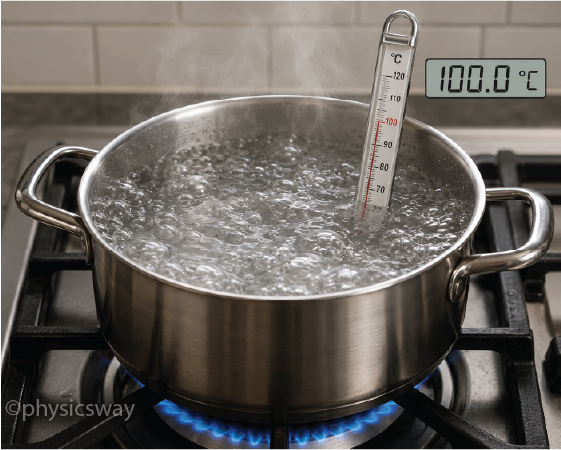
Most materials expand or contract as their temperature changes, and thermometers use this property to measure temperature. Liquids expand more than solids, which makes them a good choice; mercury is common because it stays liquid over a wide range (its freezing point is $-39\,^{\circ}\text{C}$).
Temperature scales
Three temperature scales are in common use: Celsius (also called centigrade), Fahrenheit, and Kelvin (the absolute scale). The diagram below compares them at three reference temperatures.
To convert a Celsius temperature to Fahrenheit,
$T(^{\circ}\text{F})=1.8\,T(^{\circ}\text{C})+32$
Although Fahrenheit is widely used in everyday life in the United States, it is not used in physics. Calculations are done in either Celsius or kelvin, and some equations are valid only when the temperature is expressed in kelvin.
A Celsius temperature is converted to kelvin by adding $273$:
$T(\text{K})=T(^{\circ}\text{C})+273$
The Kelvin scale is also called the absolute temperature scale, and it is discussed in more detail later in this chapter, in the section on absolute zero and the Kelvin scale. When we speak of an absolute temperature, we mean a temperature expressed in kelvin (K).
Example: Normal human body temperature is $98.6\,^{\circ}\text{F}$. What is this temperature on the Celsius scale and on the absolute (Kelvin) scale?
Solution: First convert to Celsius. Solve the conversion equation for $T(^{\circ}\text{C})$:
$T(^{\circ}\text{C})=\dfrac{T(^{\circ}\text{F})-32}{1.8}=\dfrac{98.6-32}{1.8}=\dfrac{66.6}{1.8}=37\,^{\circ}\text{C}$
Then convert the Celsius temperature to the absolute (Kelvin) scale by adding $273$:
$T(\text{K})=T(^{\circ}\text{C})+273=37+273=310\text{ K}$
Thermal equilibrium
When two objects at different temperatures are placed in thermal contact, they eventually reach the same temperature and are then said to be in thermal equilibrium. This fact is expressed by the zeroth law of thermodynamics.
The zeroth law of thermodynamics states: if two systems are each in thermal equilibrium with a third system, then they are in thermal equilibrium with each other.
More in this chapter
Thermal expansion
Linear and volume expansion of solids and liquids, with the coefficients of expansion and worked examples.
The gas laws
Atoms, molecules, elements and compounds, the mole and Avogadro's number, the gas laws and the ideal gas law, absolute zero, and Avogadro's hypothesis.
Kinetic theory of gases
The kinetic theory, average kinetic energy and rms speed, the Maxwell distribution of molecular speeds, and the kinetic theory of liquids.