
The gas laws
We begin with the particles that make up matter — atoms, molecules, elements and compounds, and the mole — and then study how the pressure, volume, and temperature of a gas are related.
Atoms and molecules
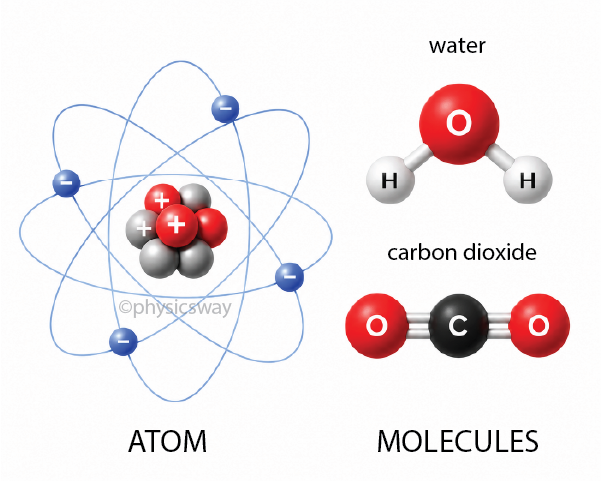
All matter is made of atoms and molecules. An atom is the basic unit of matter. Every atom has a central core called the nucleus, which is made of protons and neutrons, surrounded by electrons.
A proton carries a positive charge, an electron carries a negative charge, and a neutron has no charge. An atom has an equal number of protons and electrons, so overall it is electrically neutral.
The atomic number is the number of protons in an atom; it distinguishes one kind of atom from another.
The mass of an atom is given in atomic mass units (u). The unit is defined so that the mass of a carbon-12 atom is exactly $12\text{ u}$; that is, $1\text{ u}=\tfrac{1}{12}$ of the mass of a carbon-12 atom, which is
$1\text{ u}=1.6605\times 10^{-27}\text{ kg}$
A molecule is a group of two or more atoms bound together.
Elements and compounds
An element is a pure substance made of only one type of atom (for example carbon, gold, or copper); the smallest unit of an element is an atom.
A compound is a substance made of two or more different elements (for example water, made of hydrogen and oxygen); the smallest unit of a compound is a molecule.
The mole
The mole is the SI unit for the amount of a substance. Originally, the mole was defined so that the mass of one mole of carbon-12 is exactly $12\text{ g}$. The number of moles in a given mass of a substance is
$n=\dfrac{\text{mass (g)}}{\text{molar mass (g/mol)}}$
One mole of any substance contains $6.02\times10^{23}$ molecules, a number called Avogadro's number:
$N_A=6.02\times10^{23}\text{ molecules per mole}$
If $N$ is the total number of molecules in a substance, then
$N=n\,N_A$
Example: What is the mass of $2$ moles of water ($\text{H}_2\text{O}$)?
Solution: Rearranging the relation above gives $\text{mass}=n\times\text{molar mass}$. The molar mass of water is found by adding the masses of its atoms (two hydrogen and one oxygen):
$2(1)+16=18\text{ g/mol}$
So the mass of $2$ moles of water is
$\text{mass}=(2)(18)=36\text{ g}$
The gas laws
The pressure, volume, and temperature of a gas are related to one another. Three gas laws describe these relations: Boyle's law, Charles's law, and Gay-Lussac's law.
Boyle's law
At constant temperature, the volume of a gas increases as its pressure decreases. That is, volume is inversely proportional to pressure:
$V\propto \dfrac{1}{P}\qquad\Rightarrow\qquad PV=\text{constant}$
so for a fixed amount of gas at constant temperature,
$P_1V_1=P_2V_2$
Charles's law
At constant pressure, the volume of a gas increases with its absolute temperature:
$V\propto T\qquad\Rightarrow\qquad \dfrac{V}{T}=\text{constant}$
so
$\dfrac{V_1}{T_1}=\dfrac{V_2}{T_2}$
Gay-Lussac's law
At constant volume, the pressure of a gas increases with its absolute temperature:
$P\propto T\qquad\Rightarrow\qquad \dfrac{P}{T}=\text{constant}$
so
$\dfrac{P_1}{T_1}=\dfrac{P_2}{T_2}$
In all of the gas-law relations, the temperature $T$ must be the absolute (Kelvin) temperature.
The ideal gas law
Combining the three gas laws with the fact that the volume of a gas is proportional to the amount of gas leads to a single equation:
$PV=nRT$
where $n$ is the number of moles, $T$ is the absolute temperature, and
$R=8.314\text{ J/(mol·K)}$
is the universal gas constant. This equation is called the ideal gas law. It describes real gases well, except when the pressure is very high or the temperature is close to the temperature at which the gas liquefies.
Absolute zero and the Kelvin scale
According to Charles’s law, the volume of a gas increases linearly with temperature. If the volume-versus-temperature line is extended to lower temperatures, the volume reaches zero at about $-273\,^{\circ}\text{C}$. Any temperature lower than this temperature would give a negative volume, which is impossible, so no temperature can be lower than $-273\,^{\circ}\text{C}$.
This lowest possible temperature is the foundation of the Kelvin scale, which takes $-273\,^{\circ}\text{C}$ as its zero. That zero is called absolute zero ($0\text{ K}$). A Celsius temperature is converted to kelvin by adding $273$:
$T(\text{K})=T(^{\circ}\text{C})+273$
The Kelvin scale starts at zero and is never negative; the laws of thermodynamics show that absolute zero can be approached but never actually reached.
Example: A basketball has an inner diameter of $22.6\text{ cm}$ and contains air at a pressure of $155\text{ kPa}$. If the ball is at a temperature of $22\,^{\circ}\text{C}$, how many air molecules are inside it?
Solution: Treat the ball as a sphere. Its radius is $r=\tfrac{1}{2}(22.6\text{ cm})=11.3\text{ cm}=0.113\text{ m}$, so the volume is
$V=\tfrac{4}{3}\pi r^3=\tfrac{4}{3}\pi(0.113)^3\approx 0.00604\text{ m}^3$
With $T=22+273=295\text{ K}$ and $P=155\text{ kPa}=1.55\times10^{5}\text{ Pa}$, first find the number of moles from the ideal gas law:
$n=\dfrac{PV}{RT}=\dfrac{(1.55\times10^{5})(0.00604)}{(8.314)(295)}\approx 0.382\text{ mol}$
Then the number of molecules is
$N=n\,N_A=(0.382)(6.02\times10^{23})\approx 2.30\times10^{23}\text{ molecules}$
Avogadro's hypothesis
From the ideal gas law, at constant pressure and temperature the volume of a gas is proportional to $n$, the number of moles — and the number of moles is proportional to the number of molecules. So two samples of gas that have the same volume, at the same temperature and pressure, contain the same number of molecules. This is Avogadro's hypothesis: equal volumes of gas at the same pressure and temperature contain equal numbers of molecules.