
Work, energy and power
Definition of work
In physics, work is done by forces. If a force acting on an object displaces it, we say that the force does work on the object. So, for a force to do work, it must displace the object.In the figure below, an object is pulled by a rope with a force $\vec F$. The object has moved with a displacement of $\vec d$. How much is the work done on the object by the force?
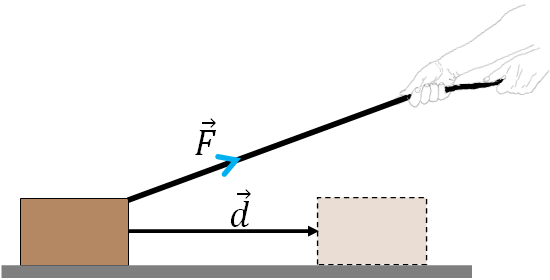
Work done by a constant force, $\vec F$ is defined as
$W=Fd\cos\theta$
where $F$ and $d$ are the magnitudes of the force and the object's displacement respectively, and $\theta$ is the angle between the force and the displacement.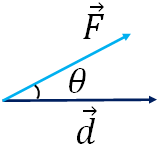
Note that the above equation is valid for any constant force. A constant force is one whose direction and magnitude do not change during the object's displacement.
If there is no displacement of the object, then $d=0$ and the work $W=0$.
When the force and the displacement are perpendicular to each other, θ = 90°, and the work is
$W=Fd \cos 90=0$
So, when a force acts on an object in one direction and the object moves in a direction perpendicular to the force, the force does no work. For example, when you walk on a horizontal surface, the force of gravity does no work on you, since it acts perpendicular to your displacement.
SI Unit of work:
The SI unit of work is the joule $(J)$, which is the same as $N.m$.Work done by gravity and work against gravity
If you drop an object, it moves vertically downward because of the force of gravity. Here, the object's displacement and the force of gravity are in the same direction, so θ = 0. If the object makes a downward displacement $h$, then the work done on it by gravity is$W=F_g h\:\cos0=mgh$.
But when you lift an object, gravity does negative work on it, because the object moves opposite to the force of gravity.
If you raise an object using a rope attached to it, the lifting force is the tension in the rope. You can also place an object on your hand and lift it by raising your hand; here the force that raises the object is the normal force exerted on it by your hand. While gravity does negative work on the object, the lifting force does positive work on it, because the lifting force and the object's displacement are in the same direction.
How much work is required to lift an object without acceleration?
Let us consider an object that is being raised by a rope. The force that raises the object is the force of tension on the rope, $F_t$.
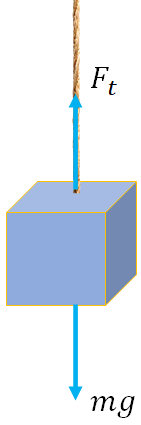
There are two forces acting on the object: $F_t$ in the upward direction and the force of gravity in the downward direction. When the object is lifted at a constant velocity, its acceleration is zero, and the force of tension balances the force of gravity,
$F_t=mg$
So, the work by $F_t$ is
$W=F_t h \cos 0=mgh$
This is the work required to lift an object to a height $h$.
Work done when you climb stairs or a ramp
When you climb stairs, you do work against gravity. Who does that work? The stairs? No — it is done by your muscles. As you walk up the stairs, your muscles lift your body against gravity. When you climb at a constant speed, the lifting force balances the force of gravity. So the work you do when you climb stairs is$W=mgh$
where $h$ is the height of the stairs.
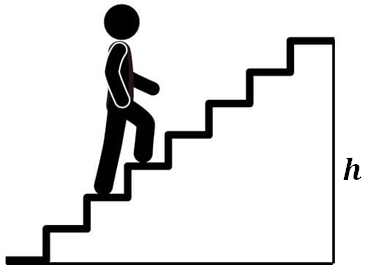
Note that the work by gravity, the work against gravity, and the work required to climb a staircase or a ramp all depend only on the height. For example, since displacement is a vector, a displacement along a ramp has two components: a vertical one and a horizontal one. The work for the horizontal displacement is zero, because the force and this displacement are perpendicular to each other. So the work depends only on the vertical displacement, which is the height. The length of the ramp does not affect the work.
Work by friction
If an object moves on a rough surface, the friction from the surface acts opposite to the object's direction of motion. Let us consider an object moving in a straight line on a surface. The object makes a displacement $\vec d$.
$W=F_{fr} d \cos180=-F_{fr}d$
$F_{fr}$ and $d$ are positive, since they are the magnitudes of the friction force and the object's displacement. So the work done by friction is always negative.
Now let us consider an object moving along the path shown below.
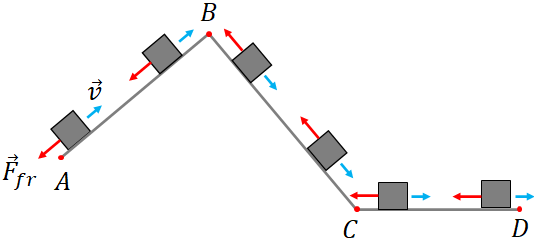
Here, the path is not a single straight line; instead, it consists of three straight segments: AB, BC, and CD. The initial and final positions of the object are A and D, so its displacement is AD. If you look at the direction of the friction force, it is not the same throughout but differs from one segment to another. That is, the force is not constant, so we cannot use the displacement AD to find the work. However, within each straight segment the force is constant, because its direction is the same at every point along that segment. So we can find the work for each segment, and then add the work for all the segments to get the total work done by friction.
Finding the work for each straight segment and adding them, we get
$W=-F_{fr}\, AB-F_{fr}\, BC-F_{fr}\, CD$
$=-F_{fr}(AB+BC+CD)$
From the figure, you can see that $AB+BC+CD$ is the total distance traveled by the object. So we can write
$W=-F_{fr} d$, where $d$ is the distance traveled by the object.
Note that in the work-by-friction equation, $d$ is the distance traveled, not the magnitude of the displacement. The above equation is valid for any path, including curved paths.
Energy
Energy is the ability to do work. If an object has the ability to do work, we say that it possesses energy. There are different forms of energy, such as potential energy, kinetic energy, thermal energy, electrical energy, and radiant energy. Kinetic and potential energy together are called mechanical energy.Kinetic energy
When an object is in motion, it has energy called kinetic energy.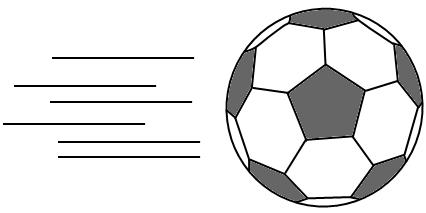
$KE=\dfrac{1}{2}mv^2$
Work-Energy Principle
When work is done on an object, the kinetic energy of the object changes. We can show that "the net work done on an object is equal to the change in kinetic energy of the object",$W_{net}=\Delta KE$.
This is called work-energy principle or work-energy theorem. The derivation of this equation is given in a separate page, derivation-of-work-energy-principle.
Potential energy
If you lift an object to some height, it acquires the ability to do work. This is because, if you release the object, its speed increases and so its kinetic energy changes. By the work-energy principle, this change in kinetic energy results from work being done on the object. The object acquired the ability to do this work because of its position, as it was raised from the ground. Similarly, if a spring is stretched or compressed, it gains the ability to do work, which you can see by releasing the spring. If an object has the ability to do work, it has energy. The energy an object possesses because of its position or state is called potential energy.Gravitational potential energy
You have learned that, to lift an object to some height, work must be done on it. This work is not wasted; instead, it is stored as the potential energy of the object. The potential energy is exactly equal to the work done to raise the object. The potential energy of a lifted object is called gravitational potential energy.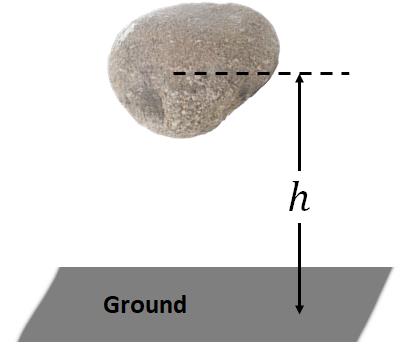
$PE_g=mgh$.
where $m$ is the mass of the object.Elastic or spring potential energy
To stretch or compress an elastic spring, a force needs to be applied on the spring.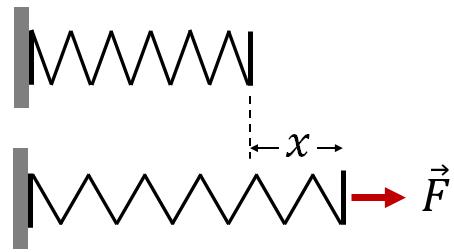
$F=kx$, where $k$ is the spring constant or force constant of the spring.
This force does a work on the spring. The work done to stretch or compress the spring is
$W=\dfrac{1}{2}kx^2$
Because of this work, the spring gains energy, which is called spring potential energy or elastic potential energy. Therefore, the elastic potential energy of a spring is
$PE_{spring}=\dfrac{1}{2}kx^2$.
Total mechanical energy
Potential and kinetic energy together are called mechanical energy. If you add the potential and kinetic energy of an object, you get the total mechanical energy of the object.$Total \:Mechanical \: energy = PE + KE$
Conservative and nonconservative forces
You saw that the work done by gravity depends only on the vertical displacement of the object. This means the work done by gravity is independent of the path; it depends only on the starting and ending positions of the object. If the work done by a force is independent of the path, the force is called a conservative force. Therefore, gravity is a conservative force. Another example of a conservative force is the force applied to stretch or compress a spring.But if the work done by a force depends on the path, that force is called a nonconservative force. Since the work done by friction depends on the path, friction is a nonconservative force.
Work and potential energy with conservative force
We can show that the work done by a conservative force is$W_c=-\Delta PE$
We can prove this by considering the work done by gravity, since the force of gravity is a conservative force. Assume an object is at some height $y_1$. Now you lift this object vertically upward to a new height $y_2$. So the vertical displacement of the object is
$h=y_2-y_1$
Finding the work by gravity,
$W=-mgh=-mg(y_2-y_1)$
$=-(mg\,y_2-mg\,y_1)$
$mg\,y_1$ is the initial gravitational potential energy and $mg\,y_2$ is the final gravitational potential energy of the object. Therefore,
$W=-\Delta PE_G$
This equation is true for gravitational potential energy as well as spring potential energy. That is, it is valid for the work done by any conservative force. So we can write$W_c=-\Delta PE$
Total work on an object or a system of objects
An object can have both conservative and nonconservative forces acting on it. So, when calculating the work done on an object, we need to consider the work done by both. The net work on an object is therefore the sum of the work done by conservative forces and the work done by nonconservative forces:$W_{net}=W_c+W_{nc}$
We have from work-energy theorem,
$W_{net}=\Delta KE$
And also we have
$W_c=-\Delta PE$
Substituting these in the net work equation,
$\Delta KE=-\Delta PE+W_{nc}$.
or$\Delta (KE+PE)=W_{nc}$.
or$\Delta E=W_{nc}$.
where $E=KE+PE$, is the total mechanical energy of the system.
Law of conservation of mechanical energy
When there is no nonconservative force (such as friction) acting on a system, $W_{nc}=0$, and we have$\Delta E=0$.
or$E_{final}-E_{initial}=0$
where $E_{initial}$ and $E_{final}$ are the initial and final mechanical energies of the object or system (if there is more than one object). From this equation, we can write$E_{initial}=E_{final}$
Thus the total mechanical energy of the system is constant; that is, the initial mechanical energy is the same as the final mechanical energy. So there is no loss in mechanical energy when there is no nonconservative force acting on the system. This is called the law of conservation of mechanical energy.Law of conservation of energy
You saw that the mechanical energy of a system is conserved when there is no nonconservative force acting on it. If there is a nonconservative force acting on the system, then we have this equation from before,$\Delta E = W_{nc}$
If friction is the only nonconservative force acting on the system, then
$W_{nc}=W_{fr}$
We have the work done by friction, which is
$W_{fr}=-F_{fr}d$, where $d$ is the distance traveled by the object under friction.
When friction does work on an object, heat is generated. Heat is a form of energy, so we call the generated heat thermal energy. The amount of thermal energy generated by friction is $F_{fr}d$.
Substituting $W_{nc}=W_{fr}=-F_{fr}d$ in the first equation, we get
$\Delta E = -F_{fr}d$
or$E_{final}-E_{initial}=-F_{fr}d$
or
$E_{initial}=E_{final}+F_{fr}d$
On the left-hand side of the equation, we have the initial mechanical energy, which is the total initial energy of the system. On the right-hand side, the second term, $F_{fr}d$, is the thermal energy. So part of the initial energy has been transformed into thermal energy, and the final mechanical energy is now lower than the initial mechanical energy. There is a transformation of energy, but nothing is lost — the total energy is always conserved. This is called the law of conservation of energy, an important law of physics.
Power
Power is the rate at which work is done. If work $W$ is done in a time $t$, then the power $P$ is$P=\dfrac{W}{t}$
Since energy is transformed when work is done, power is also the rate at which energy is transformed, i.e.,
$P=\dfrac{E}{t}$
where $E$ is the amount of energy transformed in a time interval $t$.
The SI unit of power is the watt (W), which is the same as J/s.
If you look at electric bulbs or other electrical equipment, you can see their power rating. A 100 W bulb uses 100 J of energy in 1 s. Electric utility companies charge us for how much energy our electrical equipment uses.
If the work is done by a constant force, then
$P=\dfrac{Fd \cos\theta}{t}$
$ =F\,v \cos\theta$
where $v=d/t$ is the magnitude of the object's velocity. If the object moves in the direction of the force, then $\theta =0$ and we have
$P=F\,v$
Horse power
Another common unit of power is the horsepower (hp). This is not an SI unit, but it is often used to state the power of electric motors. The horsepower was first introduced by James Watt, a Scottish engineer, in the 18th century. It is roughly the average power of a horse, i.e., the average work a horse can do per second.The conversion factor from horsepower to watt is
$1\,hp=746\,W$.