
Vectors
In 1-D kinematics, you learned that physical quantities such as displacement, velocity, and acceleration are vectors. A vector has both a magnitude (size) and a direction. A physical quantity that has no direction is called a scalar. Length, distance, and speed are scalars.In 1-D motion, we took the object's path as one of the axes ($x$ or $y$), and the object moved either in the positive or the negative direction along that axis. So, we used the sign as the direction for the vectors describing the motion. But if the path is not a straight line, as in 2-D or 3-D motion, we cannot use the sign alone as the direction. Furthermore, vectors in 1-D are simple numbers that we can add or subtract like any other numbers, which is not the case in two or three dimensions. Since we use vectors to describe motion, it is important to learn the properties of vectors in higher dimensions.
On this page, you will learn about the properties of vectors in general, with a focus on 2-D. Vectors in 3-D are similar to vectors in 2-D, just with one more dimension.
Properties of vectors
Vector notation
A vector is drawn as an arrow. The length of the arrow represents the magnitude of the vector, and the arrowhead shows its direction.
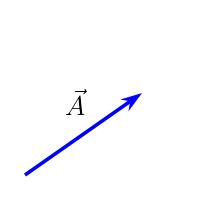
When writing a vector, we write it as a letter with an arrow over it, or as a bold letter.
That is, vector A is written as $\vec{A}$ or A.
The magnitude of a vector is its size, which is always a positive number. For vector $\vec{A}$, the magnitude is written with an absolute value symbol, $|\vec A|$, or simply as $A$ without the arrow.
Direction of a vector
We use the angle, $\theta$, that the vector makes with the $+x$ axis as the direction of the vector.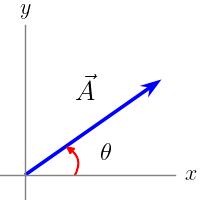
So, in the real world, if you take east as the $+x$ direction and the angle $\theta$ is 30°, then the direction of the vector $\vec A$ is 30° north of east.
Equal vectors
For a vector, only the magnitude and the direction matter; position does not. So, if you have two vectors in two different places that have the same magnitude and direction, then they are equal. This means you can move a vector without rotating it or changing its length, and it is still the same vector.Negative vector
The negative of a vector has the same magnitude as the original vector but points in exactly the opposite direction. In the figure below, vector $\vec{B}$ is on the left and its negative vector is on the right.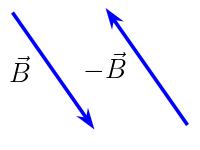
Multiplying a vector with a number
If you multiply a vector by a positive number, you get another vector with the same direction but a different magnitude. For example, if you multiply a vector $\vec{A}$ by a positive number $s$, then the magnitude of the new vector will be $sA$, and both vectors will point in the same direction.In the figure below, a vector $\vec C$ and the same vector multiplied by $2$ are shown. The magnitude (length) of the new vector is twice that of the original vector, but both point in the same direction.
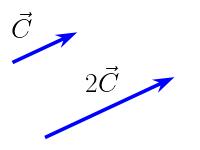
On the other hand, if you multiply a vector by a negative number, then the new vector points in the opposite direction to the original vector. The magnitude of the new vector is the absolute value of the number times the magnitude of the original vector.
Vector addition
If you add (or subtract) two or more vectors, you get another vector called the resultant vector. There are two ways to add vectors: the graphical method and the components method. The components method is also called the analytical method.Graphical methods
Assume that a person starts at point K, moves to point L, and from there moves to another point M, as in the figure.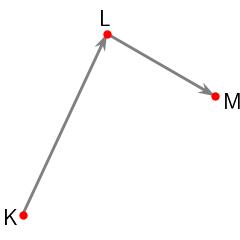
What is the displacement of the person? The net displacement is a vector drawn from the initial position K to the final position M.
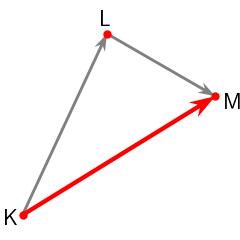
You see that the person makes two displacements, one from K to L and another from L to M. Let us take the vector from K to L as $\vec A$, the vector from L to M as $\vec B$, and the net displacement vector as $\vec R$. Now, if you add the two displacement vectors, you get the net displacement vector,
$\vec R = \vec A+\vec B$
We call the vector $\vec R$ the resultant vector of $\vec A$ and $\vec B$, since it is the sum of the two vectors.
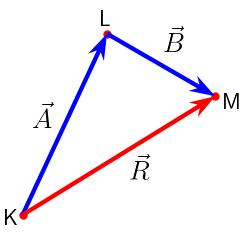
In the figure, you see that the tail (the end with no arrowhead) of the second vector $\vec B$ is connected to the tip (the end with the arrowhead) of the first vector $\vec A$, and the resultant vector $\vec R$ is drawn from the tail of the first vector to the tip of the second vector. From this, we can create a method of adding vectors, called the tail-to-tip method.
Tail-to-tip method
Suppose we have two vectors, $\vec A$ and $\vec B$, and want to add them.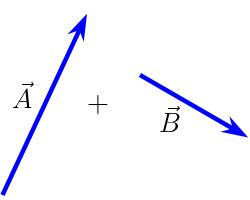
Now draw a vector from the tail of the first vector to the tip of the second vector. This is the resultant vector, $\vec R$.
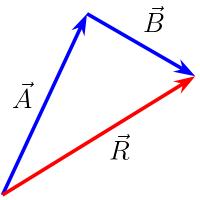
In vector addition, the order does not matter. You can switch $\vec A$ and $\vec B$, that is, take $\vec B$ as the first vector and $\vec A$ as the second vector, then apply the tail-to-tip method, and you still get the same resultant vector:
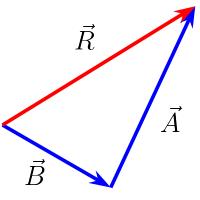
That is, $\vec A+\vec B=\vec B+\vec A$.
This is called the commutative property of vector addition.The tail-to-tip method can be used to add any number of vectors. If you have more than two vectors, connect the tail of the second vector to the tip of the first vector, connect the tail of the third vector to the tip of the second vector, and so on. Then draw a vector from the tail of the first vector to the tip of the last vector to get the resultant vector.
Parallelogram method
You can also find the resultant vector as follows. Move the vector $\vec B$ and connect its tail to the tail of the vector $\vec A$, so that both vectors start from a common point. Next, using the two vectors as adjacent sides, complete a parallelogram. Now draw a vector from the common point along the diagonal of the parallelogram. This vector is the resultant vector, $\vec R$.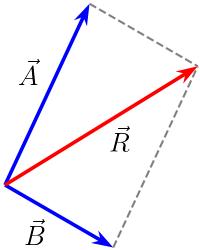
This way of adding two vectors is called the parallelogram method. It works only when there are exactly two vectors to add; if there are more than two vectors, you cannot use the parallelogram method.
Addition of parallel vectors
If two different vectors point in the same direction or in exactly opposite directions, they are called parallel vectors.Addition of parallel vectors of same direction
We have two parallel vectors $\vec A$ and $\vec B$ of the same direction, as shown in the figure below. To add them by the tail-to-tip method, move the vector $\vec B$ and connect its tail to the tip of the vector $\vec A$. The resultant vector is then drawn from the tail of $\vec A$ to the tip of $\vec B$.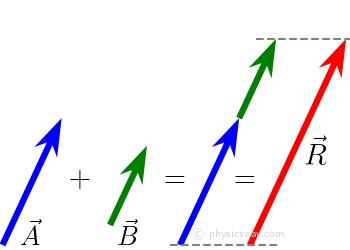
You can see that the direction of the resultant $\vec R$ is the same as that of the original vectors, and the magnitude of the resultant is the sum of the magnitudes of the two vectors,
magnitude of $\vec R = $ magnitude of $\vec A+$ magnitude of $\vec B$.
i.e., $R=A+B$.
Addition of parallel vectors of opposite directions
The figure below shows the addition of two vectors of opposite directions. The vectors $\vec A$ and $\vec B$ are parallel vectors pointing in opposite directions. If you add them by the tail-to-tip method, the resultant vector is drawn from the tail of $\vec A$ to the tip of vector $\vec B.$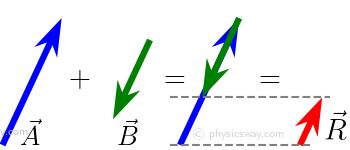
The direction of the resultant is the direction of the vector $\vec A$, which is the larger of the two vectors, and the magnitude of the resultant is $A-B$, the difference of the magnitudes of the two vectors.
i.e., $R=|A-B|$.The absolute value symbol is added to make sure that the magnitude $R$ is a positive number.
Components method
The tail-to-tip method gives you a picture of adding two or more vectors. If you draw the vectors to scale with a ruler and protractor, you can measure the magnitude and the direction of the resultant vector. With the components method, however, we can find the magnitude and the direction of the resultant vector without any drawing tools.First, you will learn about vector components, and then you will learn how to use the components to add vectors.
Components of a vector
Let us consider a vector $\vec A$ that makes an angle $\theta$ with the $+x$-axis.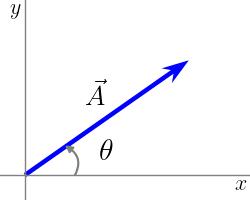
Now, draw a rectangle with the vector as one of its diagonals, as shown.
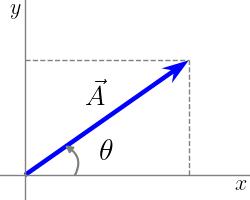
Next, draw two vectors: one along the $x$ axis on the length of the rectangle, and the other along the $y$ axis on the height of the rectangle. Let us call the vector on the $x$ axis $\vec A_x$ and the vector on the $y$ axis $\vec A_y$.
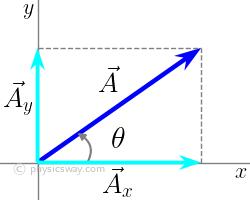
Now, you can see that the vector $\vec A$ is just the sum of the vectors $\vec A_x$ and $\vec A_y$, according to the parallelogram method,
$\vec A=\vec A_x+\vec A_y$
Thus, any vector $\vec A$ can be written as the sum of two perpendicular vectors, one along the $x$ axis and the other along the $y$ axis. We call the vectors $\vec A_x$ and $\vec A_y$ the components, or component vectors, of $\vec A$. The component vectors are 1-D vectors, since each is restricted to only one of the axes, so we drop the vector sign for them. We take $A_x$ as the $x$ component of vector $\vec A$ and $A_y$ as its $y$ component.
Finding the components of a vector
You learned that we can move a vector without rotating it or changing its length. In the figure below, you can see that the $y$ component vector has been moved from the left side of the rectangle to the right side.
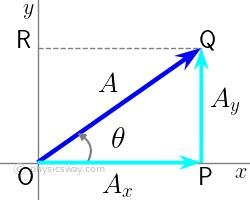
Now we have a right-angled triangle, OPQ, with $A$ as the hypotenuse and the vector components $A_x$ and $A_y$ as the sides. If you take the cosine and the sine of the angle $\theta$, you get,
$\cos\theta =\dfrac{A_x}{A}$ and $\sin\theta =\dfrac{A_y}{A}$
Solving for $A_x$ and $A_y$,
$\boxed{A_x=A\,\cos\theta\:}$ and
$\boxed{A_y=A\,\sin\theta}$
With these equations, you can find the components of a vector $\vec A$ if you know its magnitude $A$ and its direction $\theta$.
Now, applying the Pythagorean theorem to the right triangle OPQ, you get,
$\boxed{A=\sqrt{A_x^2+A_y^2}}$
This equation tells you that you can find the magnitude of a vector if you know its components.
Now, taking the tangent of the angle $\theta$, you get
$\boxed{\tan\theta=\dfrac{A_y}{A_x}}$
With this equation, you can find the direction $\theta$ of the vector $\vec A$ from its components. To find $\theta$, first compute the tangent using the equation, then take the inverse tangent.
It is important to note that the vector $\vec A$ is in the first quadrant. A vector can lie in any one of the four quadrants. In the first quadrant, both vector components are positive, because the $x$ component points to the right (the positive $x$ direction) and the $y$ component points upward (the positive $y$ direction). But if the vector is in another quadrant, this is not the case. For example, in the figure below, the vector $\vec P$ is in the second quadrant. By drawing the components of the vector, you can see that the $x$ component of $\vec P$ points in the negative $x$ direction and the $y$ component points in the positive $y$ direction. So, $P_x$ is negative and $P_y$ is positive.
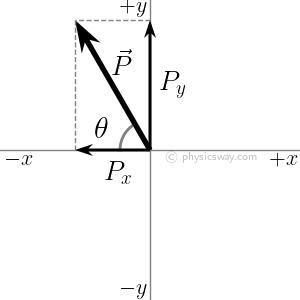
So, you must identify the sign of each component from the figure and add the appropriate sign to the equation when finding the components. If a component points in a negative direction, then you must add a minus sign. So, for the vector $\vec P$, we have
$P_x=-P\,\cos\theta$ and $P_y=P\,\sin\theta$
Components of a vector that is on one of the axes
A vector can also lie on one of the axes (or parallel to an axis). The vector $\vec F$ in the figure below is on the $x$ axis.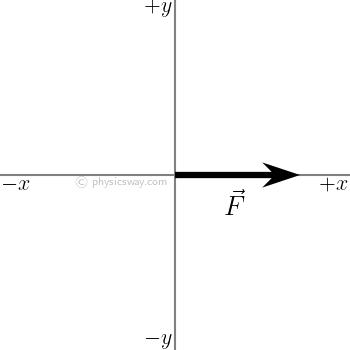
So, the angle $\theta$ that the vector makes with the $+x$ axis is zero, and thus the vector has no $y$ component. Since the vector points in the positive $x$ direction, its $x$ component is positive. So, the components of the vector $\vec F$ are
$F_x=F$ and $F_y=0$
In the figure below, the vector $\vec D$ is on the $y$ axis, so this vector has no $x$ component. Since the vector points in the negative $y$ direction, its $y$ component is negative.
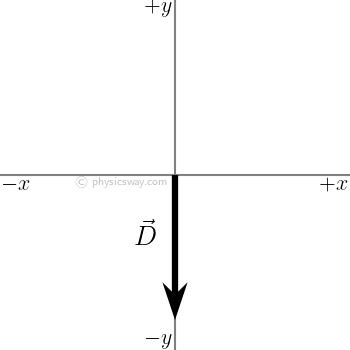
So, the components of the vector $\vec D$ are
$D_x=0$ and $D_y=-D$
Adding vector with components
In the figure, there are two vectors, $\vec A$ and $\vec B$, and you need to add them to find the resultant vector. Finding a vector means finding its magnitude and its direction. Using the tail-to-tip method, you can draw the resultant vector $\vec R$ as in the figure.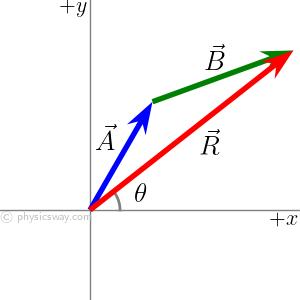
Now, the question is: what are the magnitude and the direction of the resultant vector? We can find them by using the components of the vectors $\vec A$ and $\vec B$, as you will see.
First, let us draw the $x$ and the $y$ components of the vectors $\vec A$ and $\vec B$.
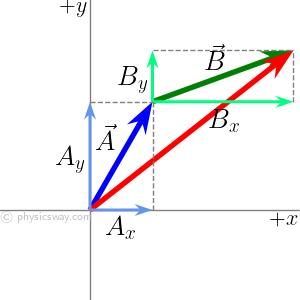
Next, add the $x$ components of the two vectors by the tail-to-tip method. Likewise, add the $y$ components of the vectors. You get the following figure.
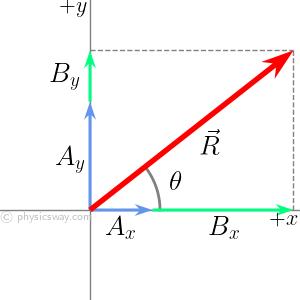
Now, you can see in the figure that the $x$ component of the resultant vector is just the sum of the $x$ components of the two vectors. That is,
$R_x=A_x+B_x$
And the $y$ component of the resultant is the sum of the $y$ components of the two vectors:
$R_y=A_y+B_y$
Once you have the $x$ and the $y$ components of $\vec R$, you can find its magnitude and direction using the equations:
$R=\sqrt{R_x^2+R_y^2}$
and$\tan\theta=\dfrac{R_y}{R_x}$
We have added two vectors by the components method, but you can add any number of vectors this way. For example, suppose you have three vectors, $\vec A$, $\vec B$, and $\vec C$. Then the resultant (sum) of the three vectors is
$\vec R=\vec A+\vec B+\vec C$.
To get the $x$ component of $\vec R$, find the $x$ components of all three vectors and add them. That is,
$R_x=A_x+B_x+C_x$.
And to get the $y$ component of $\vec R$, find the $y$ components of all three vectors and add them. That is,
$R_y=A_y+B_y+C_y$.
Now you may have a question: what do I need to do if I am subtracting one of the vectors, say $\vec B$, instead of adding it? That is,$\vec R=\vec A-\vec B+\vec C$.
In this case, you just take the opposite (change the sign) of the $x$ and the $y$ components of $\vec B$ when adding to find the components of the resultant. So,$R_x=A_x-B_x+C_x$;
$R_y=A_y-B_y+C_y$;

Problem: A truck travels 36 km in a direction 32° east of north. Next, it travels 52 km due south. Finally, it travels 64 km in a direction 28° north of west. (a) Determine how far the truck ends up from the starting point, and (b) find the direction of the truck's displacement.
Solution:
The truck makes three displacements, and each displacement is a vector. Let us label the vectors $\vec A$, $\vec B$, and $\vec C$. If you draw these vectors, you get the following figures:
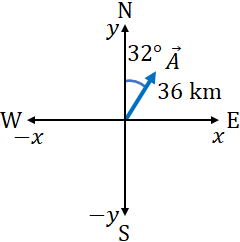
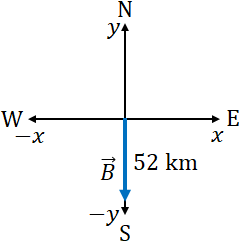
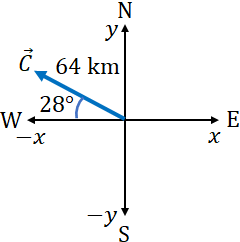
Assuming the truck starts at the origin, and adding all the vectors using the tail-to-tip method, you get the resultant vector, $\vec R$.
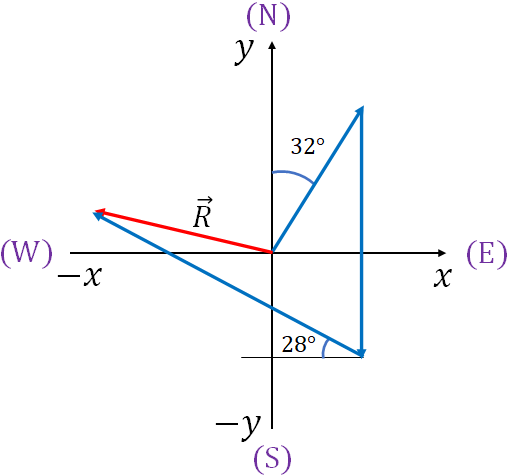
The net displacement of the truck is the resultant vector $\vec R$, drawn from the starting position to the final position of the truck. We need to find how far the truck is from the starting point, which is the magnitude $R$, and the direction of the truck's net displacement, which is the angle $\theta$ of the resultant vector.
The first step is to find the $x$ and the $y$ components of all three vectors, $\vec A$, $\vec B$, and $\vec C$.
Take the vectors one by one, and draw and find their $x$ and $y$ components.
$\underline{\vec A}$:
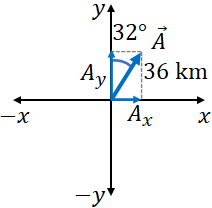
The magnitude of the vector is $A= 36 \,km$.
The components $A_x$ and $A_y$ are both positive, since $A_x$ is in the $+x$ direction and $A_y$ is in the $+y$ direction. The angle of the vector $\vec A$ is given from the $y$ axis, but in the equations we need the angle from the $x$ axis. To find the angle from the $x$ axis, subtract the given angle from 90°. So, the angle of the vector from the $x$ axis is 90° - 32° = 58°.
$A_x=+A \cos \theta = 36\,km \cos 58 = 19.08 \,km$
$A_y=+A \sin \theta = 36\,km \sin 58 = 30.53 \,km$
The values are rounded to two decimal places.
$\underline{\vec B}$:
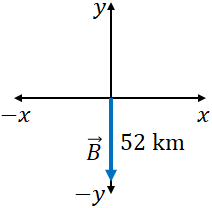
The magnitude of the vector is $B= 52 \,km$. The vector is on the $y$ axis, so its $x$ component is zero. Furthermore, the vector is on the negative $y$ axis, so its $y$ component is negative:
$B_x=0$
$B_y=-B=-52\,km$
$\underline{\vec C}$:
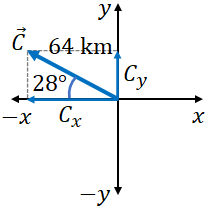
Magnitude, $C= 64 \,km$; $\theta = 28^\circ$ from the $x$ axis.
$C_x$ is negative, since it points in the negative $x$ direction, and $C_y$ is positive, since it points in the positive $y$ direction. Therefore,
$C_x=-C \cos\theta= -64\,km \cos 28=-56.51 \,km$
$C_y=+C \sin\theta= 64\,km \sin 28=30.05 \,km$
Now, add all the $x$ components of the vectors to get the $x$ component of the resultant, $R_x$. Likewise, add all the $y$ components to get the $y$ component, $R_y$.
$R_x=A_x+B_x+C_x$
$=19.08 km+0-56.51km$
$=-37.43km$
$R_y=A_y+B_y+C_y$
$=30.53 \,km-52 \,km+30.05 \,km$
$=8.58 \,km$
Now we can find the magnitude and the direction of the resultant.
The magnitude of the resultant is
$R=\sqrt{R_x^2+R_y^2}$
$=\sqrt{(-37.43)^2+(8.58)^2} \:km$
$=38.4 \,km$
Rounding to the correct number of significant figures,
$\boxed{R=38\, km}$
Now, find $\theta$ by using the equation:
$\tan \theta = \dfrac{R_y}{R_x}$
$=\dfrac{8.58}{-37.43}$
$=-0.229$
or$\boxed{\theta = -13^\circ}$
A negative $\theta$ means the vector $\vec R$ is either below the positive $x$ axis or above the negative $x$ axis. To find which one, we draw the components of $\vec R$ and then draw $\vec R$ from the components by forming a rectangle.
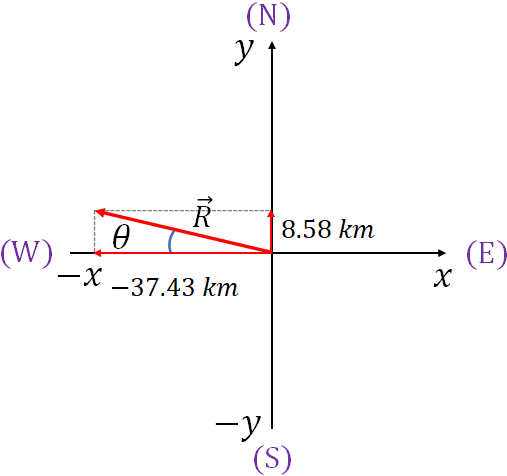
We find that $\vec R$ is above the negative $x$ axis. The tail-to-tip method also confirms this.
Since the $-x$ direction is west, the vector $\vec R$ is 13° from west, toward the north. So, the direction of the truck's displacement is 13° north of west.
Thus, the answers are:
(a) the truck ends up at 38 km from the starting point.
(b) the direction of the net displacement of the truck is 13° north of west.