
Two dimensional motion
You have studied one dimensional (1-D) motion, in which an object moves along a straight path. In two or three dimensional motion, an object moves along a curved path. If the path lies in a single plane, the motion is two dimensional (2-D); otherwise, it is three dimensional (3-D). In 1-D motion, we need only one variable, $x$ or $y$, to represent the position of the object. In 2-D motion, however, we need two variables to represent its position. One example of 2-D motion is projectile motion. On this page, you will learn about projectile motion and relative velocity in two dimensions.Projectile motion
The motion of an object launched into the air and moving only under the influence of gravity is called projectile motion, and the launched object is called a projectile. Any object moving through air experiences air resistance, but we ignore it here because it is not significant in most cases. The 1-D free fall motion you learned about earlier is also a form of projectile motion, but it is a 1-D projectile motion. Now you are going to learn about 2-D projectile motion. To distinguish 2-D projectile motion from 1-D free fall, we reserve the term projectile for the 2-D case. So, projectile motion is the motion of an object in air that is launched either horizontally or at an angle from the horizontal. We therefore exclude objects that are launched straight up or simply dropped, since those are 1-D free fall motion.In the animation below, a ball first moves along a surface and then leaves it. While the ball is on the surface, it is under the influence of the surface. But once it leaves the surface, it comes under the influence of gravity alone (ignoring air resistance). So, the ball becomes a projectile the moment it leaves the surface. Since its velocity at that moment is horizontal, this projectile is launched horizontally.
In the following animation, the projectile (the cannonball) is launched at an angle from the horizontal.
Whether a projectile is launched horizontally or at an angle from the horizontal, its path is a parabola. We can draw the path of a projectile using the equation of a parabola.
Breaking the 2-D projectile motion into two 1-D motions
The animation below shows the motion of a projectile (the ball) that is thrown into the air at an angle from the horizontal. To describe the projectile motion, we set up the frame of reference so that the $x$-axis points in the horizontal direction (parallel to the Earth's surface) and the $y$-axis points in the vertical direction (perpendicular to the Earth's surface).
In the animation, the black arrow represents the velocity vector of the projectile. The length of the arrow is the magnitude of the velocity, which is the speed of the projectile, and the arrowhead shows the direction of the velocity. You can see that both the magnitude and the direction of the velocity change continuously. First, the projectile moves upward until it reaches the highest point, and then it moves downward. As the projectile moves upward, its speed decreases until it reaches the highest point, where the speed is at its minimum. After the highest point, the speed of the projectile increases as it moves downward until it hits the ground.
Galileo studied projectile motion in the 17th century. He showed that projectile motion can be analyzed by considering the horizontal and vertical motions separately. In the animation below, the blue circle represents the horizontal motion of the projectile and the green circle represents its vertical motion. According to Galileo, the horizontal and vertical motions of a projectile are independent. That is, the motion of the blue ball does not affect the motion of the green ball, and vice versa. So, to study 2-D projectile motion, we only need to study two 1-D motions, the horizontal motion and the vertical motion, separately. And for each 1-D motion, we can use the 1-D kinematic equations.
Since we take the horizontal motion along the $x$-axis and the vertical motion along the $y$-axis, the horizontal displacement of the projectile is $\Delta x$ and the vertical displacement is $\Delta y$. We let $v_x$ and $a_x$ be the horizontal velocity and the horizontal acceleration of the projectile, and we let $v_y$ and $a_y$ be the vertical velocity and the vertical acceleration. Note that velocity and acceleration are vectors. So, $v_x$ and $v_y$ are the $x$ and $y$ components of the velocity vector, and $a_x$ and $a_y$ are the $x$ and $y$ components of the acceleration vector.
Since the horizontal and vertical motions are independent, only the $x$ components of displacement, velocity, and acceleration are related to one another. Likewise, only the $y$ components are related to one another.
To obtain the equations describing projectile motion, we start with the acceleration of the projectile.
Horizontal and vertical acceleration of a projectile
The acceleration of a projectile is caused by gravity. Gravity is a pull (a force) that acts vertically downward only. So, gravity affects only the vertical motion and has no effect on the horizontal motion. Therefore, the horizontal acceleration of a projectile is zero:i.e., $a_x=0$
Since gravity acts vertically downward, there is a vertical acceleration, which is the acceleration due to gravity. If we take upward as positive, then the vertical acceleration of the projectile is
$a_y=-g$
Initial velocity of a projectile
Every projectile has a launching velocity, called the initial velocity. We denote the initial velocity by $\vec v_0$. The magnitude of the initial velocity is $v_0$, which is the initial speed of the projectile.For a projectile launched at an angle θ above the horizontal, the initial velocity vector $\vec v_0$ and its components $v_{0x}$ and $v_{0y}$ are shown in the figure below.
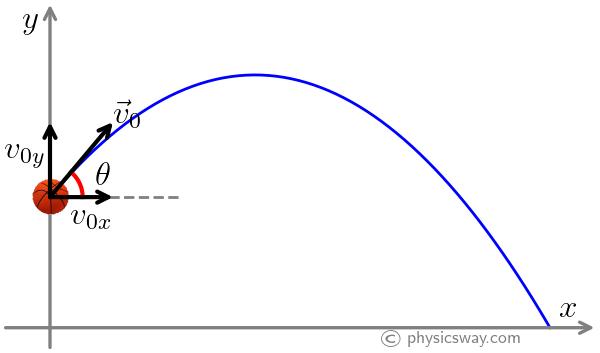
From the figure, the $x$ and $y$ components of the initial velocity are
$v_{0x}=v_0 \cos\theta$ and $v_{0y}=v_0 \sin\theta$
Note that $v_{0x}$ is simply the initial horizontal velocity and $v_{0y}$ is the initial vertical velocity of the projectile.
For a projectile launched horizontally, the initial velocity vector $\vec v_0$ points in the $+x$ direction, as in the figure below.
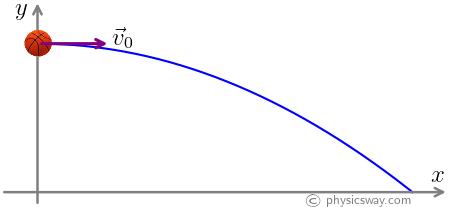
So, for a horizontal launch, the $x$ and $y$ components of the initial velocity are
$v_{0x}=v_0$ and $v_{0y}=0$.
Note that for a horizontal launch, the vertical velocity is zero.
Now we have the acceleration and the initial velocity for both the horizontal and the vertical motions. Next, we need the equations for each motion.
Equations for the horizontal motion
Since the horizontal acceleration $(a_x)$ of a projectile is zero, the horizontal velocity is constant. So, the horizontal velocity $v_x$ of a projectile at any time is the same as its initial horizontal velocity. That is,$\boxed{v_x=v_{0x}}$
We use the 1-D kinematic equations to study the horizontal motion, since it is a 1-D motion. If we substitute zero for the acceleration in the second or the third kinematic equation, we get the following equation:
$\boxed{\Delta x=v_{0x}t}$
Note that in the kinematic equation, we added the subscript $x$ to the initial velocity because we are dealing with the horizontal motion.
Equations for the vertical motion
We saw that the vertical acceleration of a projectile is the acceleration due to gravity. So, the vertical motion of a projectile is exactly the same as 1-D free fall motion. Thus, we can use the 1-D free fall equations to study the vertical motion. If we take upward as positive, then we have the following equations for the vertical motion of a projectile.$v_y=v_{0y}-gt$
$\Delta y=v_{0y}t-\frac{1}{2}gt^2$
$v_y^2=v_{0y}^2-2g\Delta y$
Note that we added a subscript $y$ to the velocities in the free fall equations to obtain the equations above, since these equations describe the vertical motion.
You learned in free fall motion that the velocity is zero at the highest point. So, at the highest point, the vertical velocity of a projectile is zero. That is,
$v_y=0$ at the highest point.
Velocity of a projectile
If you know the horizontal velocity $v_x$ and the vertical velocity $v_y$ of a projectile at any time $t$, then you can find the velocity of the projectile at that time.The magnitude of velocity (speed) of the projectile at time $t$ is
$v=\sqrt{v_x^2+v_y^2}$.
And the direction of the velocity, $\theta$, can be obtained using the equation
$\tan \theta =\dfrac{v_y}{v_x}$.
Note that this angle $\theta$ is not the same as the initial launching angle. It is different at different times, because the velocity of the projectile changes continuously.
Velocity at the highest point
If you launch a projectile at an angle above the horizontal, then there is a highest point in its trajectory. What is the velocity of the projectile at the highest point? Is it zero? At the highest point, the vertical velocity is $v_y=0$. But the horizontal velocity $v_x$ is not zero, because it is constant and is always present. So, the velocity of a projectile is not zero at the highest point. You can find the magnitude of the velocity at the highest point by substituting $v_y=0$ into the equation$v=\sqrt{v_{x}^2+v_y^2}$
$=\sqrt{v_{0x}^2+0^2}$
$=|v_{0x}|$
This is the speed of the projectile at the highest point.
Range of a projectile
The maximum horizontal displacement of a projectile is called its range.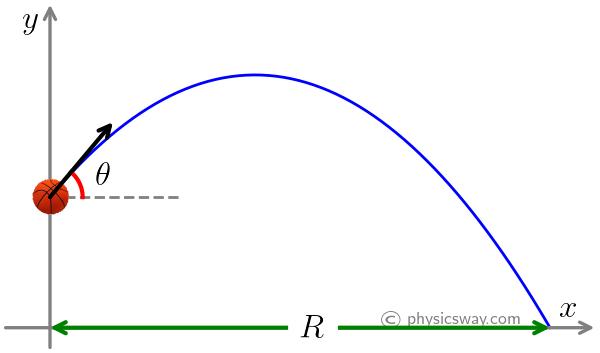
The horizontal displacement of the projectile at time $t$ is
$\Delta x = v_{0x}t$
If $t$ is the total time of flight, $t_f$, then $\Delta x$ is the range of the projectile. So, the range of a projectile is
$R = v_{0x}\,t_f$
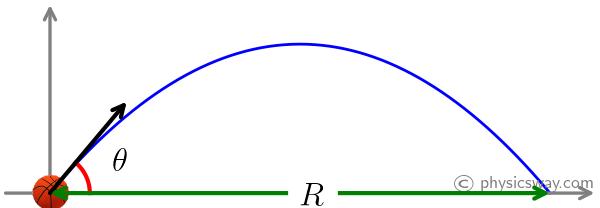
If a projectile is launched from ground level and lands at the ground, then we can obtain an equation for the range in terms of the initial speed $v_0$ and the launching angle $\theta$.
The vertical displacement is $\Delta y=0$ for a projectile that is launched from ground level and ends at the ground. Substituting $\Delta y=0$ into the second equation for the vertical motion and solving for $t$, you get
$t=\dfrac{2v_{0y}}{g}$
This is the total time of flight, $t_f$. Substituting this into the range equation, we get
$R=\dfrac{2v_{0x} v_{0y}}{g}$
We have $v_{0x}=v_0 \cos\theta$ and $v_{0y}=v_0 \sin\theta$. Substituting these into the equation, we get
$R=\dfrac{2v_{0}^2 \sin\theta \cos\theta}{g}$
Using the trigonometric identity, $2 \sin\theta \cos\theta = \sin 2\theta$,
$R=\dfrac{v_{0}^2 \sin 2\theta}{g}$
Note that this is valid only if the launching height and the landing height are the same (starting and ending at the ground). According to this equation, for a given launching speed, the range is the same for any two complementary angles. For example, suppose you throw a ball from the ground at an angle of 30° with some speed and the range is 100 m. If you then throw the ball with the same speed at an angle of 60° (which is 90 - 30 = 60), you will get the same range.
Relative velocity
The velocity of an object depends on the choice of the frame of reference. When a car is moving and you say its velocity is 50 mph, you mean the velocity is relative to the ground; that is, the frame of reference is fixed somewhere on the ground. Suppose you are traveling in a car with a friend. To you, your friend is not moving, but everything outside the car appears to move. So, for you, the velocity of your friend is zero, because you measure it with respect to a reference frame inside the car. But for a person on the ground, your friend is moving with the car. So, for that person, your friend's velocity is not zero, because they use a different frame of reference, the ground. Velocity is therefore relative: the velocity of an object relative to one reference frame is not the same as the velocity of that object relative to another reference frame.Suppose you are at point A on the bank of a river, with the water flowing from west to east. You want to cross to the other side of the river in a boat, to a point B that is exactly opposite your current position.
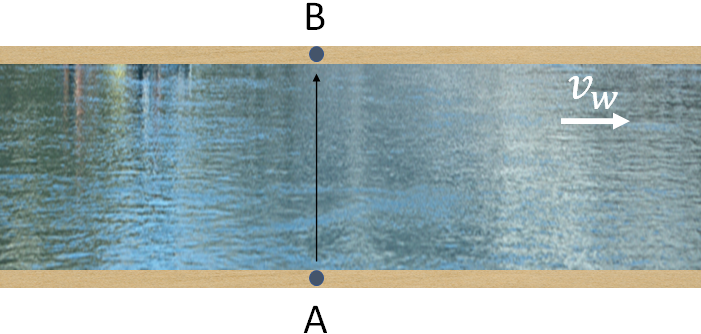
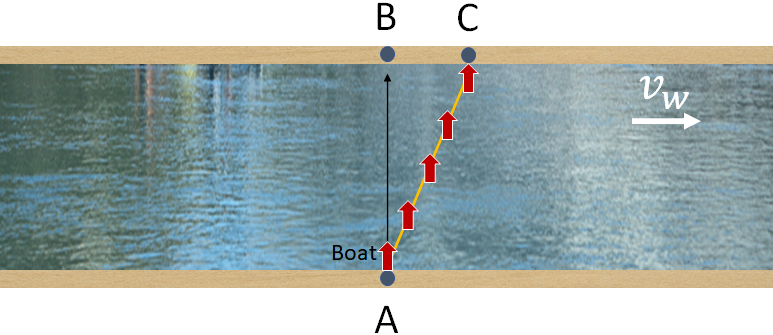
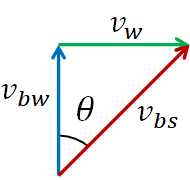
Let the velocity of the water (the river) be $v_w$. This is the velocity of the water as observed by a person on the shore (the river bank). The boat has two velocities. One is its velocity with respect to the water, $v_{bw}$. This is the velocity of the boat when the water is still, or equivalently, the velocity of the boat as observed by a person moving with the river. The other is its velocity with respect to the shore, $v_{bs}$, which is the velocity of the boat as observed by a person on the shore.
So, the boat's velocity has two components: a vertical component $v_{bw}$ and a horizontal component $v_w$ that results from the water stream. Adding these two velocity vectors gives the following right-angled triangle.
To find the downstream distance BC, consider the right-angled triangle formed by the points A, B, and C.
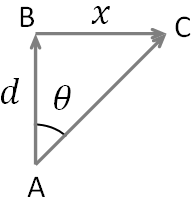
The horizontal downstream distance BC is determined by the horizontal velocity $v_w$. Therefore,
$x=v_w t$
where $t$ is the time the water takes to move from B to C. This is also the time for the boat to travel to the other side. If the water were still, the boat would take this same time $t$ to travel from A to B. So, if $d = $ AB is the width of the river, then
$t=\dfrac{d}{v_{bw}}$
Now, in order to reach point B, you need to head at a certain upstream angle, that is, at an angle from the north toward the upstream direction (west), and at a certain speed. With the correct angle and speed, the boat will have a horizontal velocity component exactly opposite to the velocity of the water stream, so the two cancel each other. The boat's velocity will then have no horizontal component, and the boat will travel due north to reach point B.
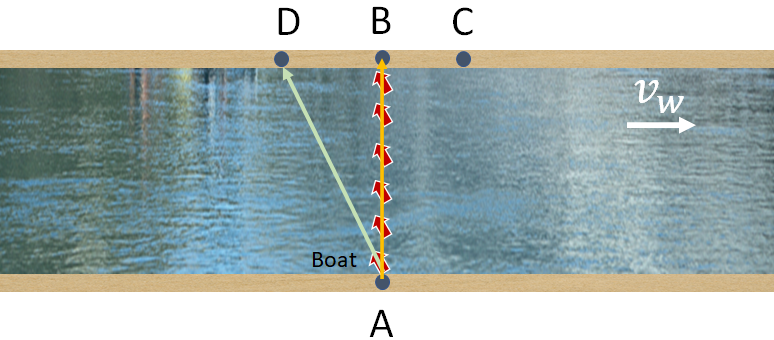
Putting all the velocity vectors together, we get the following triangle.
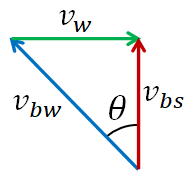
If $d$ is the width of the river, then the time to reach the other side of the river is
$t=\dfrac{d}{v_{bs}}$
Note that we used the velocity $v_{bs}$ because it is the velocity component along the width of the river.