
Rotational motion
Rotational motion is the motion of an object rotating about a fixed axis. Some examples of rotational motion are the Earth's rotation about its axis, a spinning merry-go-round, and the turning wheels of a car. Circular motion is a special type of rotational motion.In kinematics, you studied the 1-D and 2-D motion of objects, where objects move from one place to another. We will now call that motion translational, or linear, motion to distinguish it from rotational motion.
Rotating rigid body
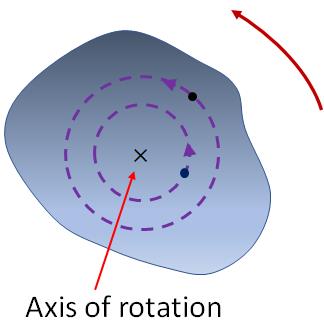
When studying the rotational motion of objects, we treat the objects as rigid bodies. What is a rigid body? A rigid body is a solid object in which the distance between any two points is constant. No external force acting on a rigid body deforms it, so the distance between any two points stays the same. In reality, though, no ideal rigid body exists, as all objects deform when a force is applied to them. In most cases, the deformation is so small that we can ignore it and treat the objects as rigid bodies.The figure below shows a rotating rigid body. To study its rotational motion, we consider it a collection of a large number of small objects, called point objects. When the rigid body rotates, all the point objects rotate about an invisible line called the axis of rotation. So the point objects move in circular motion on different circles. For a point object, the radius of its circle is its distance from the axis of rotation. The figure shows the circular motion of two point objects. Point objects closer to the axis of rotation move slower than those farther away. For example, on a merry-go-round, a person sitting farther from the center (through which the axis of rotation passes) moves faster than one sitting closer to it.
Angular displacement
The angular displacement of an object is the angle through which the object has rotated and the direction of that rotation. The direction can be clockwise or counterclockwise.Definition of angular displacement
Consider a point object in a rigid body, at a distance $r$ from the axis of rotation. When the rigid body rotates, the point object moves on a circle of radius $r$.
If the point object moves a distance $\Delta \ell$ along the circle, then its angular displacement $\Delta \theta$ is defined as
$\Delta \theta=\dfrac{\Delta \ell}{r}$
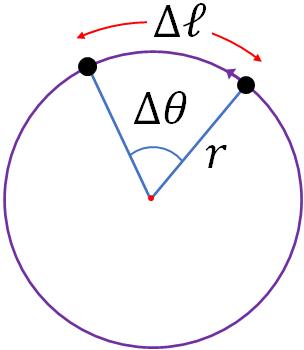
Every point on the rigid body has the same angular displacement, so $\Delta \theta$ is the angular displacement of the rigid body as a whole. Angular displacement is a vector, since it has a direction.
The SI unit of angular displacement is the radian (rad.). The common unit of angular displacement, or angle, is the degree ($^\circ$). We can find the relation between radians and degrees as follows.
When a point object makes one complete rotation, its angular displacement is $\Delta \theta= 360^\circ$. The distance traveled by the point object in one complete rotation equals the circumference of the circle, that is, $\Delta \ell = 2\pi r$. Substituting these into $\Delta \theta=\Delta \ell/r$, we get
$360^\circ=\dfrac{2\pi r}{r}\:rad.$
Canceling out the $r$'s,
$360^\circ=2\pi\:\:rad.$
or$\boxed{180^\circ=\pi\:\:rad.}$
This is the conversion factor between degrees and radians.Angular velocity
Angular velocity is the rate of change of angular displacement. It measures how fast an object is rotating.If $\Delta \theta$ is the angular displacement of an object in a time interval $\Delta t$, then the angular velocity of the object is
$\omega=\dfrac{\Delta {\theta}}{\Delta t}$
We use the Greek letter omega ($\omega$) for angular velocity.
The unit of angular velocity is $rad./s.$
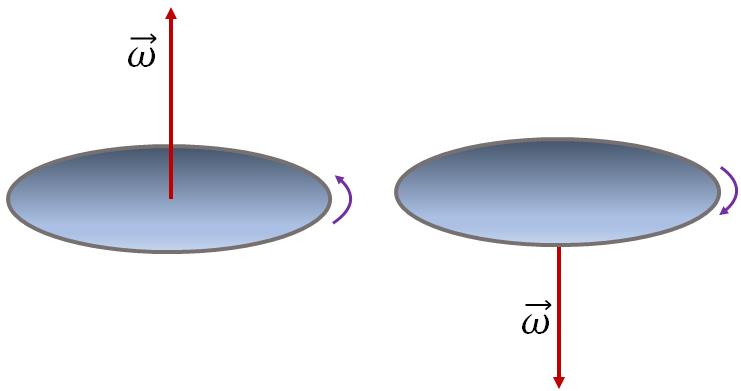
Angular velocity is a vector. The magnitude of the angular velocity is called the angular speed. The direction of the angular velocity, $\vec \omega$, is determined by a rule called the right-hand rule. It states that if you curl the fingers of your right hand around the rotation axis in the direction of rotation, your thumb points in the direction of the angular velocity.In the figure below, you can see the direction of rotation of a disc and the direction of its angular velocity.
Angular velocity and linear velocity
In translational motion, you studied the velocity, $v$, and now in rotational motion, we have the angular velocity, $\omega$. To distinguish one from the other, we call $v$ the linear velocity. The two velocities are related, as you will see below.Let us again consider a point object of a rigid body. Suppose that in a small time interval $\Delta t$, the point object travels a distance $\Delta \ell$ along its circular path. Then the angular displacement of the point object is
$\Delta \theta=\dfrac{\Delta \ell}{r}$
Dividing by $\Delta t$,
$\dfrac {\Delta \theta}{\Delta t}=\dfrac{1}{r} \dfrac{\Delta \ell}{\Delta t}$
The left-hand side is the angular velocity of the point object, or of the rigid body, $\omega$. On the right-hand side, $\Delta \ell/\Delta t$ is just the linear velocity, $v$, of the point object. So we have
$\omega =\dfrac{v}{r}$
(or)$\boxed{v=r\omega}$
The angular velocity and the linear velocity are related by this equation.Note that the angular velocity is the same for all points of a rigid body, but the linear velocity differs from point to point, since the points are at different distances $r$ from the axis of rotation.
Angular speed, period and frequency of rotation of a rigid body
The time for one full rotation of a rigid body is called the period of rotation, $T$. In one full rotation, a point object of the rigid body travels a distance equal to the circumference of its circle. Therefore, the linear speed of the point object can be written as
$v=\dfrac{2\pi r}{T}$.
Substituting, $v=r\omega$, we get,
$r \omega =\dfrac{2\pi r}{T}$.
Canceling the $r$'s,
$\omega=\dfrac{2\pi}{T}$
The reciprocal of the period is the frequency of rotation, that is, $f=1/T$. Substituting this into the equation, we get
$\boxed{\omega=2\pi f}$
So, from the frequency of rotation of a rigid body, you can find its angular speed.
Angular acceleration
Angular acceleration is the rate of change of angular velocity.Whenever the angular velocity of an object changes, there is an angular acceleration. We use the letter alpha ($\alpha$) for angular acceleration. The angular acceleration of a rigid body is
$\alpha=\dfrac{\Delta \omega}{\Delta t}$.
where $\Delta \omega$ is the change in angular velocity of the rigid body in a time interval $\Delta t$.
The SI unit of angular acceleration is $rad./s^2$.
Centripetal and tangential acceleration of a point object
When a rigid body rotates with a constant angular speed, the speed (the linear speed) of each point object is constant. In this case, the point objects are in uniform circular motion, so they have a centripetal acceleration. The centripetal acceleration of a point object moving on a circle of radius $r$ is$a_c=\dfrac{v^2}{r}$
Substituting, $v=r\omega$, and simplifying, we get
$\boxed{a_c=r\omega^2}$
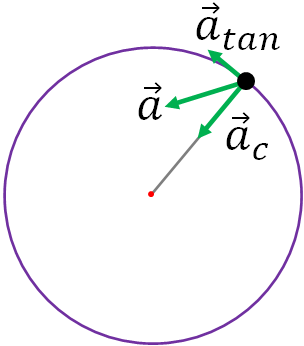
If the angular speed of the rigid body is not constant, then the speed (the linear speed) of the point objects is not constant either, so the objects are in non-uniform circular motion. An object in non-uniform circular motion has another acceleration in addition to the centripetal acceleration. This acceleration is called the tangential acceleration. The tangential acceleration of an object is
$a_{tan}=\dfrac{\Delta v}{\Delta t}$
Note that when $v$ is constant, $a_{tan}=0$ and there will only be the centripetal acceleration.
From the equation, $v=r\omega$, we can write, $\Delta v=r\Delta \omega$. Substituting this in the previous equation,
$a_{tan}=r\dfrac{\Delta \omega}{\Delta t}$
Since, $\Delta \omega/\Delta t=\alpha$, we get,
$\boxed{a_{tan}=r\alpha}$
The direction of the tangential acceleration is tangent to the circle, as shown in the figure above. Note that the tangential acceleration is the same as the acceleration in translational motion, so we also call it the linear acceleration.
Since a point object in non-uniform circular motion has two accelerations, the net acceleration $\vec a_{net}$ of the object is the vector sum of the two:
$\vec a_{net} = \vec a_c+\vec a_{tan}$
Adding the two vectors gives the direction of the net acceleration $\vec a_{net}$, as shown in the figure above.
And the magnitude of the net acceleration is
$a_{net}=\sqrt{a_c^2+a_{tan}^2}$
Rotational kinematics
We used the 1-D kinematic equations to describe the translational, or linear, motion of objects. From these equations, we can obtain another set of equations that describe the rotational motion of objects. To get them, we substitute the following into the 1-D kinematic equations:$\Delta x=r \Delta \theta$; $v=r\omega$, and $a=a_{tan}=r\alpha$
After the substitution, you can cancel the $r$ in the equations, and you will get the following:
$\omega=\omega_0+\alpha t$
$\Delta \theta=\dfrac{1}{2}(\omega_o +\omega)t$
$\Delta \theta=\omega_0 t+\dfrac{1}{2}\alpha t^2$
$\omega ^2= \omega_0^2+2\alpha \Delta \theta$
These equations are called the rotational kinematic equations.
In these equations, $\omega_0$ is the initial angular velocity of the rigid body; $\omega$ is the angular velocity at time $t$, which you can also call the final angular velocity; and $\Delta \theta$ is the angular displacement at time $t$. Note that $t=0$ is the initial time, as in the 1-D kinematic equations.
It is important to note that the rotational kinematic equations are valid only when the angular acceleration $\alpha$ is constant. This is because the 1-D kinematic equations are valid only for constant linear acceleration.
Torque
You know that in translational motion, a force accelerates an object; that is, a force is required for the linear acceleration of an object. Now the question is: what is needed for the angular acceleration of an object? A force is required for that too, but not every force can produce an angular acceleration. When a force is applied to a rotating object, the resulting angular acceleration depends on three factors: (i) the magnitude of the force, (ii) the direction of the force, and (iii) the point at which the force is applied. The physical quantity that accounts for all of these is called torque. So torque plays the role of force in rotational motion.To define torque, let us consider an object in the shape of a beam, as shown in the figure below. Assume the object can rotate freely about the axis of rotation shown, and that you apply a force $\vec F$ to the object to rotate it.
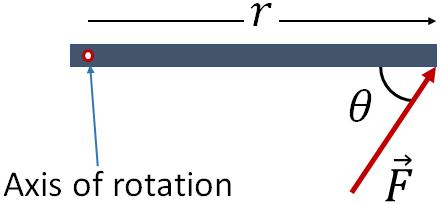
The magnitude of the torque $\tau$ exerted on the object by the force is defined as
$\tau=rF\sin \theta$
where $r$ is the distance between the axis of rotation (also called the pivot) and the point where the force is applied, and $\theta$ is the angle between the force and the line joining the pivot to the point of application.Now, draw a perpendicular line from the pivot to the force vector (extending the line of the force if needed). The length of this line is $r_\perp$, which is called the lever arm or the moment arm.
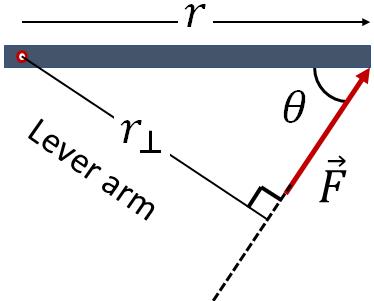
From the right angled triangle in the figure above, we can write,
$r_\perp = r \sin\theta$
So, the torque can also be written as
$\tau=r_\perp F$
Torque is also called the moment, or the moment of force. A net torque sets a stationary object rotating, or changes the angular velocity of an object that is already rotating.
Direction of torque
Torque is a vector. Its direction is determined by another right-hand rule: point your fingers in the direction from the pivot to the point where the force is applied, then curl them in the direction of the force; your thumb now points in the direction of the torque.Sign convention for torques
When you apply a torque to an object, it tends to rotate the object, either clockwise or counterclockwise. So, if more than one torque acts on an object, we need a sign convention to add them and find the net torque. We use the following convention: if a force tends to rotate the object counterclockwise, the torque due to that force is positive; if it tends to rotate the object clockwise, the torque is negative.Torque on a rotating point object
Again, consider a point object in a rigid body. To rotate the point object, you need to apply a force to it. But only the force, or the force component, tangent to the circle can rotate the object.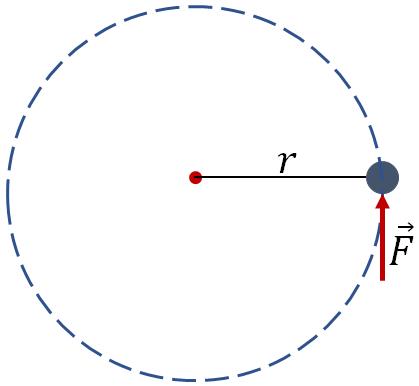
$\tau=rF$.
where $r$ is the radius of the circle.
Since the force accelerates the object tangentially, we have
$F=ma_{tan}=mr\alpha$
Substituting this in the torque equation,
$\tau=mr^2\alpha$.
This is the equation for the torque on a point object.
Torque on a rotating rigid body
We have the torque acting on a rotating point object, and we can use it to find the torque on a rotating rigid body. Again, assume the rigid body is made up of a large number of point objects, $n$ of them in total. When the rigid body rotates, all the point objects rotate with the same angular acceleration but on circles of different radii. Let $m_1, m_2, m_3, ..., m_n$ be the masses of the point objects and $r_1, r_2, r_3, ..., r_n$ the radii of their circular paths. Adding the torques on all the point objects gives the torque on the rigid body. The torque on the rigid body is therefore$\tau=m_1r_1^2\alpha+m_2r_2^2\alpha+...m_nr_n^2\alpha$
$\tau=(m_1r_1^2+m_2r_2^2+...m_nr_n^2)\alpha$
or$\tau=I\alpha$
where $I = m_1r_1^2+m_2r_2^2+...m_nr_n^2$
$I$ is called the moment of inertia of the rigid body about the axis of rotation.
The moment of inertia of a rigid body depends on its mass, its shape, and the axis of rotation. Using calculus, we can find the moment of inertia of rigid bodies of different shapes.
The moments of inertia of objects of various shapes and axes of rotation are given in the table below. $M$ in the table is the mass of the object.
| Object | Axis of rotation |
Moment of inertia |
|---|---|---|
|
Uniform sphere 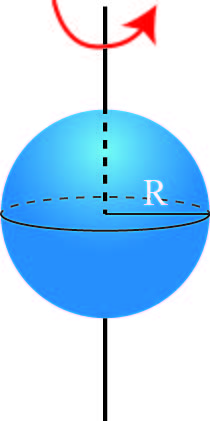
|
Through center |
$\dfrac{2}{5}MR^2$ |
|
Solid cylinder 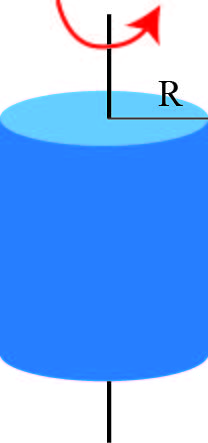
|
Through center |
$\dfrac{1}{2}MR^2$ |
|
Hollow cylinder 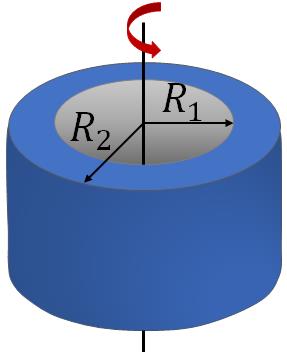
|
Through center |
$\dfrac{1}{2}M\left(R_1^2+R_2^2\right)$ |
|
Long 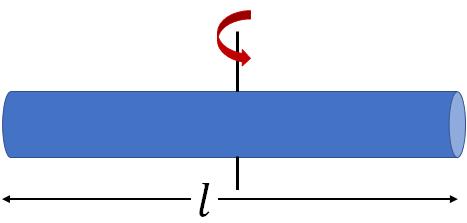
|
Through center |
$\dfrac{1}{12}Ml^2$ |
|
Long 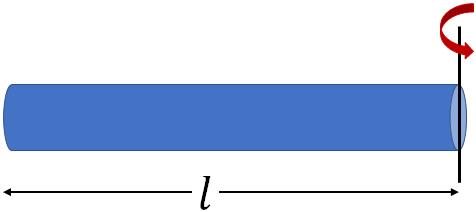
|
Through one end |
$\dfrac{1}{3}Ml^2$ |
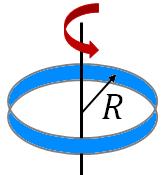
Thin hoop
|
Through center |
$MR^2$ |
|
Thin hoop 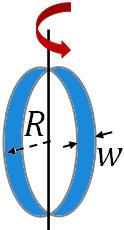
|
Through central diameter |
$\dfrac{1}{2}MR^2+\dfrac{1}{12}Mw^2$ |
|
Rectangular 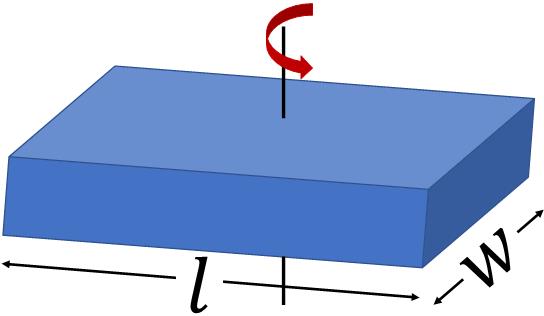
|
Through center |
$\dfrac{1}{12}M\big(l^2+w^2\big)$ |
Rotational kinetic energy
A rotating object has kinetic energy, just like an object in translational motion. To find the kinetic energy of a rotating object, we use the same strategy we used to find the torque on a rigid body. Assume the rigid body is made up of a large number of point objects. As the body rotates, each point object rotates with the same angular velocity but with a different linear velocity, because of its different radius. The total kinetic energy of the body is the sum of the kinetic energies of the point objects. Therefore,$KE_{rot}=\dfrac{1}{2}m_1v_1^2+\dfrac{1}{2}m_2v_2^2+...+\dfrac{1}{2}m_nv_n^2$.
where $\omega$ is the angular velocity of the rigid body.
Substituting $v=r\omega$, we have
$KE_{rot}=\dfrac{1}{2}m_1r_1^2\omega^2+\dfrac{1}{2}m_2r_2^2\omega^2+...$.
$+\dfrac{1}{2}m_nr_n^2\omega^2$
$KE_{rot}=\dfrac{1}{2}(m_1r_1^2+m_2r_2^2+...+m_nr_n^2)\omega^2$
or$KE_{rot}=\dfrac{1}{2}I\omega^2$
where $I$ is the moment of inertia of the object about the axis of rotation.
With this equation, you can find the rotational kinetic energy of a rotating rigid body.
Kinetic energy of a rolling object
If an object undergoes both rotational and translational motion on a surface, we call that rolling motion. When you ride a bike, the wheels are in rolling motion, since they rotate about their axle and also translate from one place to another. A rolling object has both translational and rotational kinetic energy. Moreover, a rolling object rotates about its center of mass. Therefore, the total kinetic energy of a rolling object is$KE=\dfrac{1}{2}mv^2+\dfrac{1}{2}I_{cm}\omega^2$
where $I_{cm}$ is the moment of inertia of the object about its center of mass.
Work and power in rotational motion
Work in rotation
Torque does work on a rotating object in the same way that a force does work on an object undergoing a linear displacement.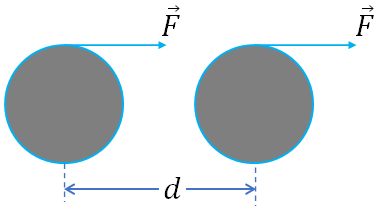
To derive the equation for the work done by a torque, consider a wheel with a rope around its rim. Assume you pull the rope with a force of magnitude $F$, so that a point on the rim moves a distance $d$. The work done by the force is then
$W=F\, d$.
We can relate the distance $d$ to the angle $\Delta \theta$ through which the wheel rotates by
$d=r\Delta \theta$
Substituting this into the above equation gives
$W=F\, r \Delta \theta$
$F\, r$ is just the torque on the wheel, so we can write
$W=\tau \Delta \theta$
Thus, when a torque rotates an object, the torque does work on the object.
Power in rotation
You learned that power is the amount of work done per unit time. If $W$ is the work done in a time $\Delta t$, then the power generated is$P=\dfrac{W}{\Delta t}$
Substituting, $W=\tau \Delta \theta$,
$P=\tau \dfrac{\Delta \theta}{\Delta t}$
Since $\dfrac{\Delta \theta}{\Delta t}=\omega$, the power generated by torque is
$P=\tau \omega$
Angular momentum
Angular momentum in rotational motion is analogous to linear momentum in translational motion. The angular momentum $(L)$ of a rotating object is defined as$L=I\omega$
where $I$ is the moment of inertia about the axis of rotation of the object.The unit of angular momentum is $kg.m^2/s$.
Since the angular momentum is proportional to the angular velocity, its direction is the same as that of the angular velocity.
Torque and angular momentum
We have the relation between the torque and the angular acceleration of a rigid body,
$\tau=I\alpha$.
$=I\dfrac{\Delta \omega}{\Delta t}$
$=\dfrac{\Delta (I\omega)}{\Delta t}$
(or)$\tau=\dfrac{\Delta L}{\Delta t}$
That is, the torque is just the rate of change of angular momentum.
Comparing angular momentum with linear momentum, you can see that force is the rate of change of linear momentum, while torque is the rate of change of angular momentum.
Conservation of angular momentum
You learned in the chapter on linear momentum that when there is no net external force acting on a system (an isolated system), the linear momentum is conserved.Likewise, angular momentum is conserved when there is no net torque acting on a rigid body, as you will see below.
We have,
$\tau=\dfrac{\Delta L}{\Delta t}$
Putting, $\tau=0$,
$\dfrac{\Delta L}{\Delta t}=0$
$\Delta L=0$
or$L=$ constant
That is, the angular momentum is constant when there is no net torque acting on a rotating object; in other words, the angular momentum of the object is conserved.
So, if $L_1$ and $L_2$ are the initial and final angular momenta of a rotating object or system, then
$L_1=L_2$