
Oscillations and waves
Oscillation is a repetitive change of an object’s position from one point to another. If an oscillation takes the same amount of time in each cycle (repetition), it is called a periodic oscillation. Examples of periodic oscillation are an oscillating pendulum and the vibrating strings of a guitar.Mechanical wave is the oscillation of matter, which transfers energy through a material medium.
Oscillating spring-mass system
Consider a spring with a mass attached to it and the mass is on a smooth surface (frictionless surface).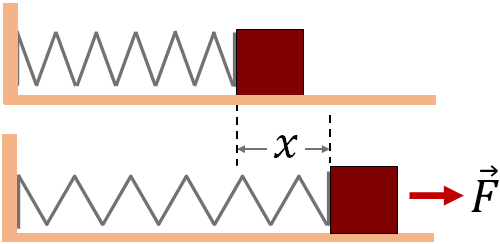
When you apply a force on the mass to stretch the spring, the spring exerts an equal force on the mass in the opposite direction. The force exerted by the spring is called the restoring force:
$F_s=-kx$
Due to the restoring force, if you now remove the force on the mass, the mass will oscillate back and forth on the surface. If you pull the mass a distance $A$ from the equilibrium position ($x=0$) and release it, the mass will oscillate between $-A$ and $A$. We call $A$ the amplitude of oscillation.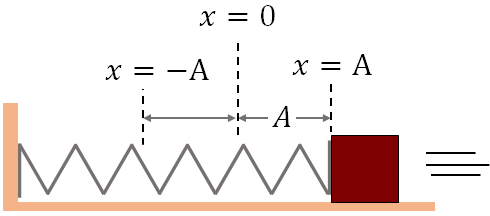
The total energy of the spring-mass system is the kinetic energy of the mass and the potential energy of the spring:
$E=\dfrac{1}{2}mv^2+\dfrac{1}{2}kx^2$
At the extreme positions of the mass, $v=0$, therefore
$E=\dfrac{1}{2}kA^2$
The mass has its maximum velocity at the equilibrium position, i.e., at $x=0$. The energy of the system at the equilibrium position is therefore,
$E=\dfrac{1}{2}mv_{max}^2$
$v_{max}=A\,\sqrt{\dfrac{k}{m}}$
Acceleration of the mass
The restoring force by the spring is the only force responsible for the motion of the mass and is also the only force acting on the mass. So, the acceleration of the mass using Newton's second law is$a=\dfrac{F_s}{m}=\dfrac{kx}{m}$
Period and frequency of oscillation of a spring-mass system
The period or the time for one complete oscillation is$T=2\pi \sqrt{\dfrac{m}{k}}$
In my following video, you can find the derivation of this formula.
And the frequency of oscillations is obtained by taking reciprocal of the period:
$f=\dfrac{1}{2\pi}\sqrt{\dfrac{k}{m}}$Simple harmonic oscillation
In any oscillating system, there must be a restoring force to continue the oscillation. If the restoring force on an oscillating system is proportional to the negative of the displacement (displacement can be linear, $x$ or angular $\theta$), we call the system a simple harmonic oscillator and the oscillation, simple harmonic oscillation.i.e., for a simple harmonic oscillator, the restoring force is
$F=-constant\times x$
(or)$F=-constant\times \theta$
A spring-mass system is a simple harmonic oscillator as its restoring force is proportional to the negative of the displacement, $x$ of the mass.The Simple Pendulum
A simple pendulum is a mass (bob) suspended from a string.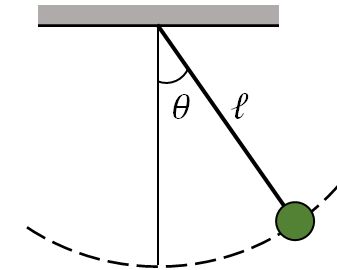
A detailed description of a simple pendulum and how to derive its period is given in my video.
The period of oscillation of the pendulum is
$T=2\pi\sqrt{\dfrac{l}{g}}$
where $l$ is the length of the pendulum and $g$ is the acceleration due to gravity.This equation is valid for small amplitudes or angles of oscillations.
The equation tells you that the period of a pendulum depends on its length and is independent of the mass of the bob. So whether you have a 1 kg bob or a 5 kg bob, the period will be the same as long as the lengths are equal.
Mechanical waves
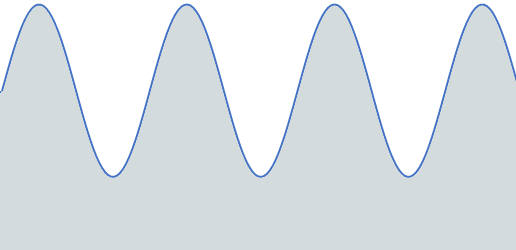
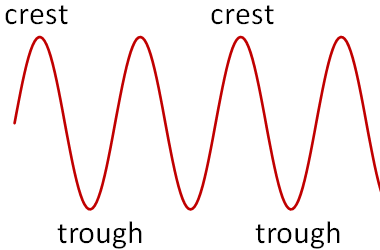
A wave is a disturbance that transfers energy from one place to another without any transfer of mass. Water waves and waves on a rope are mechanical waves, which propagate as oscillations of matter. When waves move, the particles of the medium do not move with the waves but oscillate about an equilibrium position. In water waves, water molecules move up and down. In a rope, the particles of the rope oscillate up and down.There are two types of waves, transverse and longitudinal waves. When a wave propagates, if the particles of the medium vibrate perpendicular to the direction of propagation, we call that a transverse wave. Examples of transverse waves: waves on a cord/string and water waves.
Wave speed, wavelength, period and frequency
Wave speed is the speed at which any point on the wave appears to move forward.Wavelength $(\lambda)$ is the distance between two successive crests or troughs of a transverse wave. Actually wavelength is the length of one full wave. To get a full wave, you choose a point on the wave of some height and move forward until you get a point on the wave that has the same height.
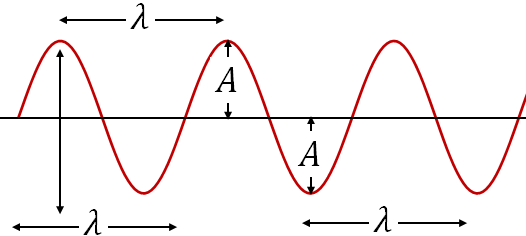
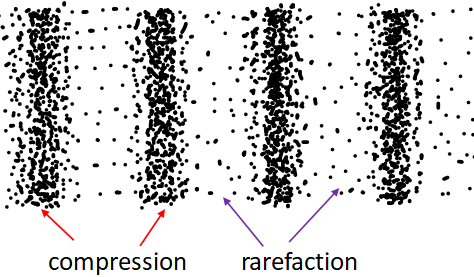
In a longitudinal wave, wavelength is the distance between successive compressions (or rarefaction).
Period $(T)$ is the time taken for one full wave to pass a given point, and frequency $(f)$ is the number of waves that pass a given point per unit time.
It takes a time of $T$ for a wave to travel a distance equal to $\lambda$; therefore, the wave speed is$v=\dfrac{\lambda}{T}$
Since $f=\dfrac{1}{T}$, we have
$v=\lambda f$
Note that the frequency of a wave is generally determined by the source that produces the wave, but the speed is determined by the medium in which the wave propagates.
Speed of transverse waves on a string
The speed of a transverse wave on a cord or an attached string is$v=\sqrt{\dfrac{F_t}{\mu}}$
where $F_t$ is the tension on the string and $\mu=m/l$ , where $m$ is the mass of the string and $l$ is its length. $\mu$ is called, the mass per unit length.Energy and intensity of waves
When a wave propagates it carries energy. Energy of a wave is proportional to the square of the amplitude of the wave:$E\propto A^2$
Intensity $(I)$, of a wave is the energy, the wave transports per unit time across unit area perpendicular to the direction of propagation.
$I=\dfrac{E}{Area.t}$
If you move away from the wave source, the intensity of the wave decreases with distance as inverse square law:$I\propto 1/r^2$
Standing waves
When a string is plucked, it vibrates up and down. Waves are created that appear not to travel. Such waves are called standing waves. Standing waves are formed when two opposing waves are combined.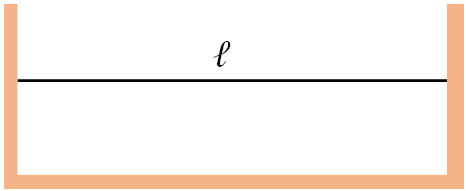
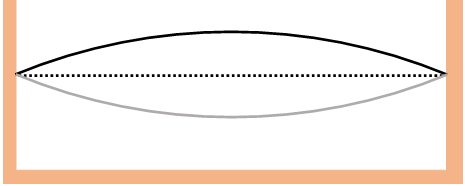
$l=\lambda_1/2$
(or)$\lambda_1 = 2l$
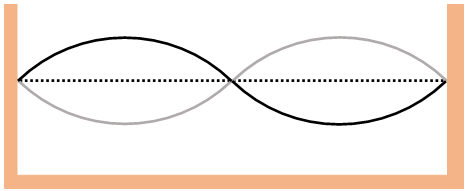
$l=\lambda_2$, where $\lambda_2$ is the wavelength of the wave.
(or)$\lambda_2 = l$
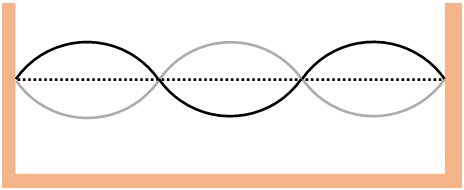
$l=\dfrac{3}{2} \lambda_3$
(or)$\lambda_3 = \dfrac{2l}{3}$
Here we took only three standing waves, with wavelengths $\lambda_1$, $\lambda_2$ and $\lambda_3$. These wavelengths are called the resonant wavelengths of the string. Actually, there are an infinite number of possible resonant wavelengths. We can find all the resonant wavelengths with the following equation:
$\lambda_n=\dfrac{2l}{n}$ where $n=1,2,3 ...$
By using $v=f \lambda$, we can write the frequencies of the waves:
$f_n=n \dfrac{v}{2l}$ where $n=1,2,3, ...$
These frequencies of the standing waves on a string are called the resonant frequencies or natural frequencies of the string.The frequency corresponding to $n=1$, i.e., $f_1=\dfrac{v}{2l}$, is called the fundamental frequency. All other frequencies (except the fundamental) are called overtones. All the resonant frequencies corresponding to $n=1,2,3, ...$, i.e., $f_1,f_2,f_3, ...$, are called harmonics. $f_1$ is the first harmonic, $f_2$ is the second harmonic and so on.