
Kinematics: One dimensional motion
Physics has many branches, one of which is mechanics. Mechanics itself is divided into kinematics and dynamics. Kinematics is the study of the motion of objects without considering the causes of that motion (the forces). In other words, in kinematics we do not need to know why an object is moving or what makes it move.One-dimensional (1-D) kinematics, or 1-D motion, refers to the motion of objects along straight-line paths. Examples include a car traveling on a straight road, an object dropped from rest, and a football kicked vertically upward. When studying one-dimensional motion, we do not consider the size or shape of the object; instead, we treat it as a point. In 1-D motion, the locations of this point at different times all lie along a single straight line.
Position of an object
The position of an object is its location in space. To specify an object's location, we need a reference. For this purpose, we use the Cartesian coordinate system, which consists of three mutually perpendicular axes: $x$, $y$, and $z$. This system is called a frame of reference, or simply a reference frame.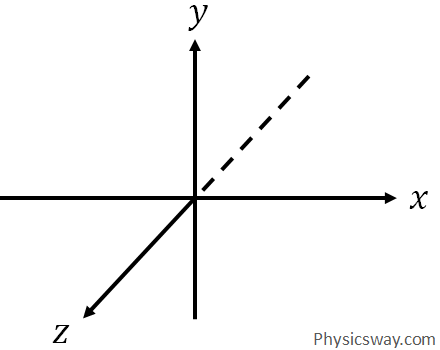
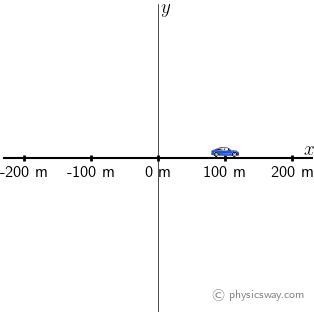
Since an object in one-dimensional motion moves along a straight-line path, we consider this path as one of the coordinate axes — usually the $x$-axis, or sometimes the $y$-axis. If the $x$-axis is taken as the path, then the letter $x$ represents the position of the object; if the $y$-axis is taken as the path, then the letter $y$ represents the position. In the following figure, the position $x$ of the blue car is 100 m. The meter (m) is the SI unit of position.
Direction of motion
In 1-D motion, an object can move in only two directions: the positive direction and the negative direction. If the position of the object (its $x$ value) increases, we say the object is moving in the positive direction; if the position decreases, we say the object is moving in the negative direction. In the figure below, the red object moves in the positive direction, and the green object moves in the negative direction.The positive direction can be any direction we use in everyday life — north, south, east, west, or any other. The choice of which direction to call positive is arbitrary; the direction opposite to it is then taken as negative. For example, if you choose east as the positive direction, then west becomes the negative direction, and vice versa.
Distance and displacement
Distance and displacement are two different quantities in physics.If an object moves from a point A to another point B, the distance traveled by the object is the length of the path from A to B. There may be many available paths from A to B, each of a different length. In the figure below, there are two possible paths from A to B: a shorter path, path 1, and a longer path, path 2. If the object takes path 2, it travels a greater distance than on path 1. So the distance depends on the path taken by the object. Since distance is a length, it is a positive number. Distance also has no direction, because the distance traveled from A to B is the same as the distance from B to A along the same path. A quantity that has no direction is called a scalar, so distance is a scalar.
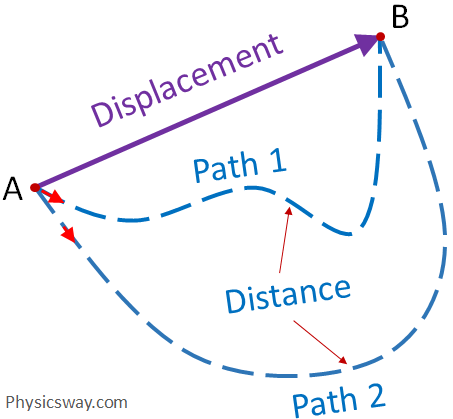
The displacement of an object is a measure of how far the object has moved from its starting point and in what direction. To find the displacement, draw a straight line with an arrow from the initial point to the final point (see the figure above). The length of this straight line is the size of the displacement, called the magnitude of the displacement. The arrow, which points away from the initial position and toward the final position, shows the direction of the displacement. So displacement has both a magnitude and a direction. Any quantity that has both magnitude and direction is called a vector, so displacement is a vector. The displacement line (the straight line with the arrow) is called the displacement vector.
Displacement is independent of the path, since you only need the initial and final positions of an object to find its displacement.
If an object makes a round trip and comes back to its starting point, then its displacement is zero. The distance, however, is not zero. The distance is simply the length of the loop if the object makes one round trip around it, and twice that length if it makes two round trips.
The SI unit of distance and displacement is the meter (m).
Displacement in a 1-D motion
In 1-D motion, we can define the displacement asdisplacement, $\Delta x=x_2-x_1,$
where $x_1$ is the initial position of the object and $x_2$ is its final position.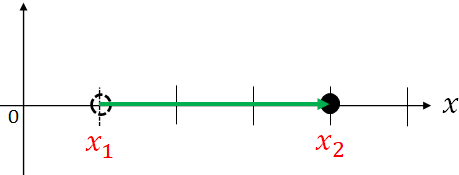
The displacement $\Delta x$ is positive for an object moving in the positive direction, since $x_2\gt x_1$ in that direction. And $\Delta x$ is negative for motion in the negative direction, since there $x_2 \lt x_1$. So in 1-D motion, the sign of the displacement reflects its direction.
Note that you cannot directly compare distance and displacement, because displacement has a direction but distance does not. You can, however, compare the distance and the magnitude of the displacement, since both represent a length. Unless the motion is one dimensional and in a single direction, the magnitude of the displacement is smaller than the distance traveled by the object.

Example: A car travels 5 km due east on a straight road, then turns back and travels 3 km due west. Find the distance traveled by the car and its displacement.
Solution:
The distance traveled by the car is the length of the path it covers. That is,distance $= 5 km + 3 km=8 km$.
The car travels on a straight road, so the motion is one dimensional. To find the displacement, we need the initial and final positions of the car. To locate these positions, we set up a frame of reference and take the car's path along the $x$ axis. Let the car start from the origin (you could choose another point too). So the initial position of the car is
$x_1=0$.
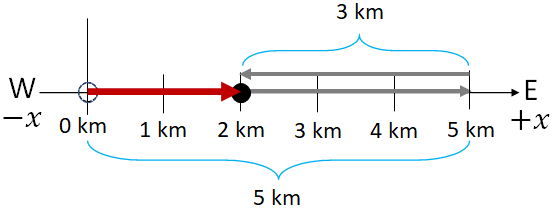
I took east as the positive direction, so west is the negative direction. Since choosing which direction is positive or negative is arbitrary, it does not matter if you take west as the positive direction and east as the negative.
The car first travels $5\,km$ due east, so it reaches $x=5 km$. Then it turns back and travels 3 km westward. So the final position of the car is
$x_2= 2 \,km$.
A straight line drawn from the initial to the final position, with an arrow pointing toward the final position, is the displacement vector. Since the arrow points east, the direction of the displacement is eastward.
With the initial and final positions, we can find the displacement of the car.
The car's displacement is
$\Delta x = x_2-x_1= 2 km -0 = 2km$.
The displacement is a positive number, so its direction is positive. Since we took east as the positive direction, the displacement is eastward — which we already knew from the arrow of the displacement vector.
The absolute value of the displacement is its magnitude, which is 2 km.
So the answers are:
Distance traveled by the car $= 8 km$.
Displacement of the car is 2 km eastward (write the magnitude first, then the direction).
Speed
Speed is how fast an object is moving. To find the speed of a moving object, measure the distance the object travels over a time interval and divide that distance by the time interval. So the speed of an object is defined as$speed=\dfrac{distance}{time}$
Speed can be instantaneous or average. Instantaneous speed is the speed at an instant of time. The speedometer of your car shows the instantaneous speed — the speed of the car at the moment you look at it. Average speed is the speed you determine by observing the motion of the car between two times (that is, over a time interval) rather than at an instant. For example, suppose you drive your car for 10 minutes and travel a distance of 2 km. Dividing the distance by the time, you get 0.2 km/min. This is the average speed, because it is not the speed at one instant but the speed determined between two times separated by an interval of 10 minutes.
Why do we use the word average for the speed measured over a time interval? Because during the time interval the object can have different instantaneous speeds at different moments, so what you get is the average of those speeds. If the object moves at a constant speed throughout the time interval, then the average speed equals the instantaneous speed. Also, when a speed is instantaneous, we usually drop the word instantaneous and simply say speed.
Now another question may arise: how can one find the instantaneous speed without a time interval over which to travel some distance? Indeed, you cannot travel a distance without spending some time. So the instantaneous speed shown by the speedometer is not exactly instantaneous; it is an average speed over a very small time interval around the moment of interest — much smaller than the human response time. So instantaneous speed is really the average speed over a small time interval. How small should the time interval be? It depends on how quickly the object's speed changes around the moment of interest and on the accuracy needed.
Speed has no direction, because speed is distance over time and distance has no direction. So speed is always positive, like distance.
For a comprehensive overview of speed, please refer to the following video.
Velocity
Just as speed is related to distance and time, there is another quantity, called velocity, that relates displacement and time.If an object makes a displacement $\Delta x$ in a time interval $\Delta t$, then the velocity of the object is
$\bar v=\dfrac{\Delta x}{\Delta t}$,
where $\bar v$ is the average velocity. We call this velocity the average because it is the velocity over a time interval between two different times, not at a single instant. The bar over the letter $v$ denotes the average.If $t_1$ is the initial time and $t_2$ is the final time, then $\Delta t=t_2-t_1$. Note that $\Delta t$ is always positive, since time never decreases ($t_2>t_1)$.
Instantaneous velocity is the velocity at a single instant of time, which is really the velocity over a very small time interval. We write the instantaneous velocity as $v$, without the bar. Note that when we simply say velocity, we mean the instantaneous velocity.
Velocity is a measure of how the position of an object changes per unit time. In SI units, the velocity of an object tells us by how many meters its position changes every second.
Since displacement is a vector and velocity is displacement over time, velocity is a vector. The direction of the velocity is the direction of the object's displacement, which is the direction of its motion. In 1-D motion, the velocity is positive if the object is moving in the positive direction and negative if it is moving in the negative direction. For example, if you take north as the positive direction and the object is moving due south, then its velocity is negative.
Note that the magnitude of the average velocity is not always the same as the average speed. If an object travels on a straight path in one direction, then the magnitude of the average velocity equals the average speed. But if the object travels back and forth on a straight path, or moves on a curved path, during the time interval of interest, then the magnitude of the average velocity is smaller than the average speed.
When an object is in motion, it needs some time to change its direction. So you can see that, over a sufficiently small time interval, every object moves along a straight-line path in one direction. Therefore, over a small time interval, the magnitude of the average velocity of an object equals its speed. Since the average velocity over a small time interval is the instantaneous velocity, the magnitude of the instantaneous velocity is just the speed of the object.
You can show that the velocity of an object is the slope of its position versus time graph, as follows.
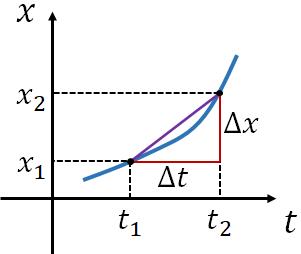
In the figure above, the position of a moving object at different times is graphed. Let us consider the motion of the object over a time interval from $t_1$ to $t_2$. Here $x_1$ and $x_2$ are the positions of the object at $t_1$ and $t_2$, respectively. If you draw a line between the points $(t_1, x_1)$ and $(t_2, x_2)$ and find its slope, you get
slope $=\dfrac{x_2-x_1}{t_2-t_1}$
$=\dfrac{\Delta x}{\Delta t}$
$=\bar v$
Thus the slope of the line drawn between any two points corresponding to two times is just the average velocity over the time interval between those times. Now the question is: if you take a single instant of time, how is the velocity related to the slope? For a single time, the slope of the tangent drawn at the point corresponding to that time is the velocity at that time. So velocity is just the slope of a position versus time graph.
As an example, an object's position ($x$) versus time ($t$) is graphed below. I have selected four points, A, B, C, and D, corresponding to four different times, and the tangents at A, B, C, and D are shown. The velocity of the object at a given time is the slope of the tangent at the point corresponding to that time; that is, the velocity of the object at $t=2s$ is the slope of the tangent at A.
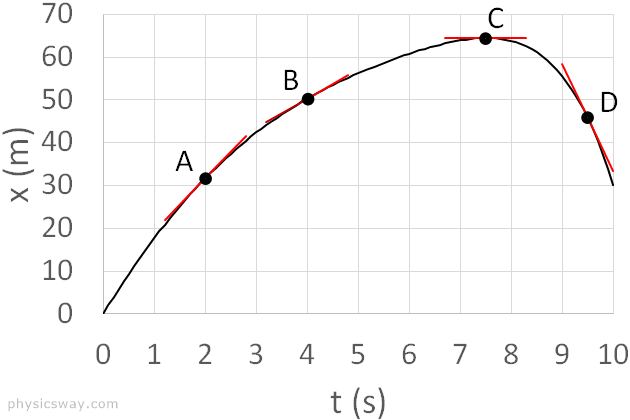
The slopes of the tangents at A and B are positive, and the slope of the tangent at C is zero (the tangent is a horizontal line). So the velocities at $t=2s$ and $t=4s$ are positive, and at $t=7.5s$ the velocity of the object is zero. The slope of the tangent at D is negative, so at $t=9.5 s$ the velocity is negative. From these we can conclude that the object moves in the positive direction up to point C, stops there, then turns back and moves in the opposite (negative) direction.
Acceleration
When the speed of a car is increasing, we say the car is accelerating. And when the car slows down, we say it is decelerating. In both cases, the velocity of the car changes. In physics, we say there is an acceleration whenever there is a change in the velocity of an object.The acceleration of an object is defined as
acceleration $=\dfrac{change\:in\:velocity}{time}$
If the velocity of an object changes from $v_1$ to $v_2$ in a time interval $\Delta t$, then the acceleration of the object is
$\bar a=\dfrac{\Delta v}{\Delta t}$,where $\bar a$ is the average acceleration and $\Delta v = v_2 - v_1$ is the change in velocity. We call $v_1$ the initial velocity and $v_2$ the final velocity.
Like velocity, acceleration can be average $(\bar a)$ or instantaneous $(a)$.
Acceleration is a measure of how the velocity changes per unit time. In SI units, acceleration tells us by how much the velocity changes every second. For example, an acceleration of magnitude $7 m/s^2$ means that every second the speed of the object increases or decreases by $7 m/s$.
We can show that, in a velocity versus time graph of an object (with time $t$ on the $x$-axis and velocity $v$ on the $y$-axis), the slope of the graph is the acceleration of the object. This is the same as showing that velocity is the slope in a position versus time graph.
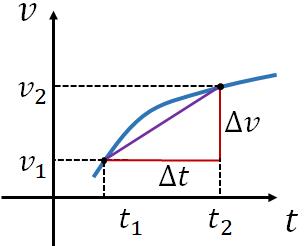
Since velocity is a vector and acceleration is the change in velocity over time, acceleration is also a vector. In 1-D motion, the acceleration and velocity of an object are in the same direction if the object is speeding up, and in opposite directions if it is slowing down. We can prove this as follows.
Assume an object is moving in the positive direction at some speed, say $3 m/s$. This is the instantaneous speed, which is the magnitude of the velocity. The object accelerates for, say, $1 s$, so that its speed at the end of the $1 s$ is, say, $5 m/s$. Since the object is moving in the positive direction, the initial and final velocities are positive:
$v_1= 3 m/s$ and $v_2= 5 m/s$.
So the acceleration of the object is
$a=\dfrac{ v_2-v_1}{\Delta t}$
$= \dfrac{5 m/s-3 m/s}{1 s} = + 2 m/s^2$
The acceleration and the velocity are both positive, so they are in the same direction.
Now let us consider an object moving in the negative direction at some speed, say $2 m/s$, that speeds up to $6 m/s$ over a time period of $1 s$. Since the object is moving in the negative direction, the velocities are negative:
$v_1= - 2m/s$ and $v_2= -6 m/s$.
Finding the object's acceleration,
$a=\dfrac{v_2-v_1}{\Delta t}$
$= \dfrac{-6 m/s -(-2 m/s)}{1 s} = - 4 m/s^2$
Here again the acceleration and the velocity are in the same direction, since both are negative.
Now let us consider an object moving in the positive direction but slowing down. As the object slows down, its final speed is smaller than its initial speed. Assume the initial speed is $6m/s$ and the final speed is $3 m/s$, and take $\Delta t = 1 s$. Since the motion is in the positive direction, we have
$v_1 = 6m/s$ and $v_2 = 3m/s$.
The acceleration of the object is
$a=\dfrac{3 m/s - 6 m/s}{1 s}=- 3 m/s^2$.
The acceleration is negative and the velocity is positive, so they are in opposite directions. You get the same result if the object is moving in the negative direction. So when an object is slowing down, its acceleration and velocity are in opposite directions.
It is important to note that the sign of the acceleration depends on two things: the sign of the velocity (that is, the direction of motion) and whether the object is speeding up or slowing down. So a negative acceleration does not always mean the object is slowing down, and a positive acceleration does not always mean it is speeding up.
1-D kinematic equations
In 1-D motion, we will mostly deal with constant acceleration. When the acceleration of an object is constant, its average acceleration over a time interval is the same as the instantaneous acceleration at any instant during that interval. It is like taking the average of identical numbers: the average of identical numbers is just one of those numbers.For a constant acceleration $a$, we have a set of four equations that relate the time and the object's displacement, velocity, and acceleration. These are called the 1-D kinematic equations. Their derivations are given on a separate page: deriving the kinematic equations.
The 1-D kinematic equations are:$v=v_0+at$
$\Delta x=\dfrac{1}{2}(v_0+v)t$
$\Delta x=v_0t+\dfrac{1}{2}at^2$
$v^2 = v_0^2 + 2a \Delta x$
In the 1-D kinematic equations, $t=0$ is the initial time, and $t$ is the time interval between the initial and final times. For example, $t = 2 s$ means that $2 s$ has passed since the object's motion started. Here $v_0$ is the initial velocity, that is, the velocity at $t=0$, while $\Delta x$ and $v$ are the displacement and velocity at time $t$, respectively.Free fall motion
Isaac Newton, an English physicist, discovered gravity in the 1680s. He found that objects are attracted toward the earth by gravity. That is why, if you drop or throw an object, it eventually comes back down instead of continuing to rise. But long before Newton, Galileo Galilei, an Italian astronomer and physicist, discovered that, in the absence of air resistance, all objects fall with the same acceleration regardless of their masses. That is, if you drop a $1 kg$ object and a $10 kg$ object at the same time from the same height, both hit the ground at the same time.
However, if you simultaneously drop a feather and a rock from the same height, you can see that they do not reach the ground at the same time; the rock reaches the ground before the feather. This is because of air resistance. Air resistance affects the feather more than the rock because the feather has a larger surface area per unit mass. But if you place the feather and the rock inside a long evacuated cylinder and drop them, both hit the bottom at the same time.
An object moving above the earth's surface under the influence of gravity alone is said to be in free fall. An object moving through air, however, has air resistance acting on it in addition to gravity. We can ignore air resistance in most cases, except for objects like a feather or a piece of paper. So, ignoring air resistance, any object that you drop or throw into the air is called a freely falling object, and its motion is called free fall motion. In every case we deal with in this section, we will ignore air resistance.
If you drop an object, or throw it exactly vertically upward or downward, you can see that the object follows a straight line relative to the earth. For example, if you throw a ball vertically upward, it comes back to the exact point from which it was thrown. So the motion of such an object (dropped or thrown vertically upward or downward) is one dimensional. We will focus on 1-D free fall motion in this section.
Let us see what happens when you throw an object vertically upward. The animation above shows the motion of a ball thrown vertically upward with some initial velocity. The green arrow represents the velocity and the blue arrow represents the acceleration of the ball. You can see that the speed (the magnitude of the velocity) of the ball decreases as it rises, until it stops at some point, and then comes back down. As the ball falls, its speed increases. Whether the ball is going up or coming down, its acceleration is always directed downward. This is because, when the ball is going up, its speed decreases, so the acceleration is opposite to the direction of motion — that is, downward; and when the ball is coming down, its speed increases, so the acceleration is in the same direction as the motion — again downward. Thus the acceleration always points downward.
The acceleration of a freely falling object is called the acceleration due to gravity. We will use the letter $g$ to represent the magnitude of the acceleration due to gravity. If you measure the acceleration of a freely falling object near the surface of the earth, you get $g=9.80 m/s^2.$ This value is constant unless you go too far from the earth's surface.
Since the acceleration due to gravity is constant near the surface of the earth, we use the 1-D kinematic equations to describe 1-D free fall motion. Because the motion is vertical (perpendicular to the earth's surface), we take the path of the object along the $y$ axis. So we use the variable $y$ for the object's position and $\Delta y$ for its vertical displacement. The equations we use to study free fall motion are:
$v = v_0 +a t $
$\Delta y = v_0 t + {1\over 2} a t^2 $
$v^2 = v_0^2 + 2a \Delta y$
Since choosing which direction is positive or negative is arbitrary, we can take either upward or downward as the positive direction.
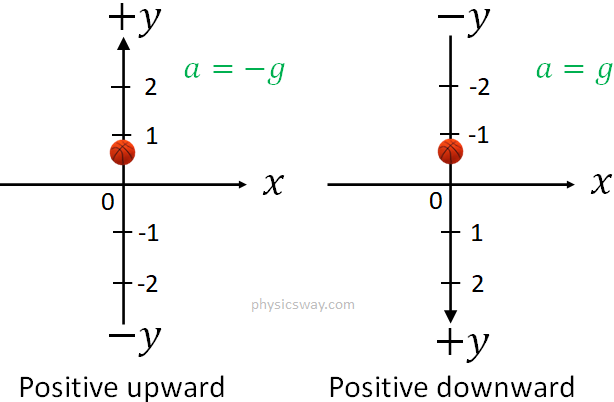
If you take upward as positive, then the acceleration of the object is negative, because the acceleration due to gravity is downward. So you substitute $a=-g$ into the equations above.
And if you take downward as positive, then the acceleration is positive, so you substitute $a=g$ into the equations.
When solving problems, check which way the object is moving initially: upward or downward. If the object is moving upward, take upward as positive. If the object is moving downward, take downward as positive.