
Dynamics: Forces and Newton's laws
Dynamics is a part of mechanics. It is the study of forces and their effects on motion. On this page you will learn about the different types of forces, Newton's three laws, and how to apply Newton's laws to solve problems.What is a force ?
A force is a push or pull on an object. If you push an object, you are applying a force to it. An object can exert a force on another object with or without direct contact. A dropped object falls toward the Earth due to gravity, which is a force. Here, the Earth exerts the force of gravity on the object without any direct contact.When a force is exerted on an object, its effect depends on both the size (magnitude) and the direction of the force. So force is a vector.
Newton's Laws of Motion
There are three fundamental laws of motion, formulated by Isaac Newton and published in 1687. They are called Newton's first law, Newton's second law, and Newton's third law.Newton's first law
It states that "when there is no net force acting on an object, an object at rest stays at rest, and an object in motion continues to move in a straight line."An object can be at rest or in motion; this is its state. So changing the state of an object means: (i) if the object is at rest, we make it move; and (ii) if the object is in motion, we change its velocity. A velocity change can be in magnitude (a change in speed) or in direction. What Newton's first law says is that to change the state of an object, we must apply a net force to it. The net force on an object is the sum of all the forces acting on it. So, to change the speed or the path of an object, a net force must be applied to it. Therefore, without a net force, an object moves at a constant speed in a straight line.
Every object resists changes to its state. That resistance is called the object's inertia. Mass is a measure of an object's inertia, because the heavier the object (the more mass), the more force is required to change its state. Since Newton's first law is about overcoming an object's inertia, it is also called the law of inertia.
Newton's second law
This law relates force and acceleration. Newton's second law states that "the acceleration of an object is directly proportional to the net force acting on it, and inversely proportional to the object's mass."i.e., acceleration, $\vec{a}=\dfrac{\vec{F}}{m}$
where $\vec{F}$ is the net force on the object, and $m$ is the mass of the object.The first law says that to accelerate an object—that is, to change its velocity—you must apply a net force to it. The second law lets you calculate that acceleration.
If an object moves with a constant velocity, then its acceleration is zero. With no acceleration, the net force on the object is zero. So a force is not required to keep an object in motion; force is required only to accelerate an object.
Newton's second law is generally written in the following form:
$\vec{F}={m}\vec{a}$
Unit of force: The SI unit of mass is $kg$ and that of acceleration is $m/s^2$. If you multiply these two units, you get the unit of force. So the unit of force is $kg\cdot m/s^2$. We call this unit the newton, or $N$. So we use the newton ($N$) as the SI unit of force.
How much is $1N$ of force? It is the force required to accelerate a $1kg$ object by $1m/s^2$. For example, if there is a $1 kg$ ball at rest on the ground and you kick it so that in $1s$ the ball attains a speed of $1 m/s$, then you have applied a force of $1 N$ to the ball.
Newton's second law in components form
Since force is a vector, its $x$ and $y$ components are independent. So, if an object is moving along the $x$ axis, only the $x$ component of the net force affects the motion—and likewise for motion along the $y$ axis. So we can write Newton's second law in component form as$F_x={m} a_x$ and $F_y={m} a_y$
where $F_x$ and $F_y$ are the $x$ and the $y$ components of the net force on the object, and $a_x$ and $a_y$ are the $x$ and the $y$ components of the object's acceleration.Newton's third law
It states that "whenever an object exerts a force on a second object, the second object exerts an equal amount of force on the first in the opposite direction."Newton's third law can also be stated as, "for every action there is an equal and opposite reaction."
According to Newton's third law, forces always act in pairs: a force and its reaction force. The magnitudes of the force and the reaction force are the same, regardless of the sizes (masses) of the objects involved. For example, if a small car and a big truck are involved in a collision, the force the truck exerts on the car is the same as the force the car exerts on the truck, but the two forces point in opposite directions. Although the forces are equal, the smaller object accelerates at a higher rate because of its smaller mass, according to Newton's second law.
Force of gravity (weight)
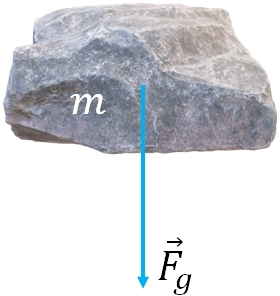
$\vec {F}=\vec{F_g}$
Applying Newton's second law, $\vec F = m\vec a$, we get
$\vec {F_g}=m\vec{a}$
where $m$ is the mass of the object and $\vec a$ is its acceleration.
You learned in kinematics that any falling object near the surface of the Earth has an acceleration of magnitude $g$. Since the acceleration is downward, it is negative when we take upward as positive:
$\vec a= -g$
Substituting this in the above equation, we get,
$\vec {F_g}=-m g$
The sign of the force of gravity depends on which direction you choose as positive. It is negative here because I take upward as positive. But the magnitude of the force of gravity is a positive number:
$\boxed{F_g=m g}$
When a falling object hits the ground, the Earth doesn't stop pulling it. The Earth still pulls the object with the same force, but the ground keeps it from moving any further. So the force of gravity always acts on an object, whether the object is in motion or at rest. The force of gravity is also called weight. Weight and mass are not the same: weight is a force, while mass is not.
Normal force
If an object rests on a horizontal surface, then the net force acting on it is zero. But you know there is a force of gravity acting on the object in the downward direction. Since the net force on the object is zero, there must be a vertical force acting on it to cancel the downward gravitational force. That upward force is called the normal force, $\vec F_n$.The normal force acts perpendicular to the surface. On a horizontal surface, it balances the force of gravity and keeps the object from falling further.
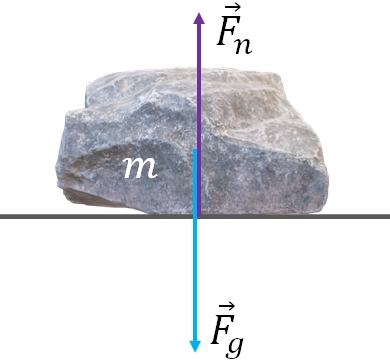
So, on a horizontal surface, with no forces other than gravity acting on the object, the magnitude of the normal force equals the weight of the object:
$F_n=mg$
Scale reading and normal force
Suppose you place an object on a scale. The scale shows some reading. Now, if you push the object down slightly with your finger, you will see the scale read more than before. And if you grab the object and slowly pull it upward, you will see the scale read less than before. This shows that what the scale reads is not always the actual mass of the object. So what does the scale read?
What a scale reads is the normal force—the normal force exerted on the object by the surface of the scale. When you push or pull the object, you apply a force that changes the normal force, so you see different scale readings. The normal force is called the apparent weight of the object. Scales (such as a bathroom scale) are calibrated to show mass in $kg$ or $lb$, which is just the normal force divided by $g$. Note that the mass $m$ of an object does not change, but the mass reading on the scale does. So we call the mass read by a scale the apparent mass, $m'$. The apparent mass is
$m'=\dfrac{F_n}{g}$.
If the scale and the object are at rest or moving at a constant speed (see below for more), and no other forces act on the object, then the scale reads the actual mass of the object, $m'=m$.
Apparent weight in an elevator
If you have ever been in an elevator, you may have noticed that when it starts moving upward from rest, you feel heavier than normal. When it starts moving downward from rest, you feel lighter than normal. And when the elevator is moving at a constant speed, you feel no difference in weight. The reason is that the weight you feel is the normal force exerted on you by the floor of the elevator. When the elevator is at rest or moving at a constant speed, that normal force equals your actual weight. When the elevator is accelerating upward, the normal force is greater than your actual weight, and when it is accelerating downward, the normal force is smaller. The following problem demonstrates this.
Problem: A scale is in an elevator and a $55kg$ woman is standing on the scale. Determine what the scale will read
(A) if the elevator ascends with an increasing speed at a rate of $2.1m/s^2$,
(B) if the elevator descends with an increasing speed at a rate of $2.1 m/s^2$ and
(C) if the elevator is moving at a constant speed (upward or downward).
Solution: To solve this problem, the first step is to draw a free body diagram. The object in this problem is the woman, so we need to consider all the forces acting on her.
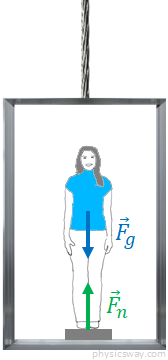
There are two forces acting on the woman: the force of gravity (her weight) and the normal force from the surface of the scale. Both forces are vertical: the normal force points vertically upward and gravity points vertically downward. Taking upward as positive, the net force on the woman is
$F=F_n-mg$
Applying the Newton's second law, $F=ma$, we get
$F_n-mg=ma$
where $a$ is the acceleration of the woman, which is the same as the acceleration of the elevator, since the woman and the elevator move together as one unit.
This is the main equation for an elevator problem.To find the scale reading, we need the normal force. From the equation,
$F_n=mg+ma$
Now let us consider the cases.
(A) The elevator ascends with an increasing speed at a rate of $2.1m/s^2$.
Here the elevator is moving upward. Since we take upward as positive, the elevator is moving in the positive direction. The elevator is speeding up, so the acceleration is in the same direction as the motion—the positive direction. So the acceleration is positive:
$a=+2.1 m/s^2$
$m=55kg$, the mass of the woman.
All the quantities are in SI units. By substituting the known values, we can find the normal force:
$F_n=55 \cdot 9.80 +55\cdot 2.1$
$=654.5 N$
Since the scale reads in $kg$, divide the normal force by $g$ to get the scale reading in $kg$.
$m'=\dfrac{F_n}{g}$
$=\dfrac{654.5}{9.80}$
$=67\, kg$
You see that the scale reading is greater than the mass of the woman. That is why you feel heavier when the elevator starts moving upward—that is, when the elevator is accelerating upward.
(B) The elevator descends with an increasing speed at a rate of $2.1 m/s^2$.
In this case, the elevator is moving downward and speeding up, so the acceleration points downward, in the negative direction:
$a=-2.1 m/s^2$
Substituting the values in the $F_n$ equation, you will get,
$F_n=55 \cdot 9.80 +55\cdot (-2.1)$
$=423.5 N$
And the scale reading is
$m'=\dfrac{423.5}{9.80}$
$=43\, kg$
(C) the elevator is moving at a constant speed (upward or downward).
When the elevator moves upward (or downward) at a constant speed, its velocity is constant, since both speed and direction are constant. So the acceleration of the elevator (and the woman) is zero:
$a=0$.
Substituting this in the normal force equation:
$F_n=mg+m\cdot 0$
$=mg$
Therefore, $m'=\dfrac{F_n}{g}=m= 55\, kg$
That is, the scale reading is the actual mass. So when the elevator moves at a constant speed, you feel no difference in your weight.
Tension or force of tension
If you use a flexible cord to pull an object, you are applying a force to the object through the cord. Such a force is called the force of tension, or just tension, $\vec F_t$. Tension is a pulling force transmitted through a flexible cord such as a cable, rope, or chain.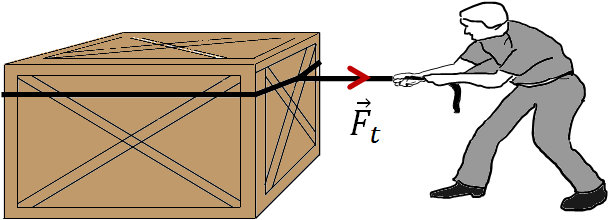
Free body diagram
When you are solving problems in dynamics, the first step is to draw a diagram showing all the forces acting on the object. Such a diagram is called a free body diagram, or force diagram. It should show the directions of the forces with arrows and their approximate magnitudes (through the lengths of the force lines).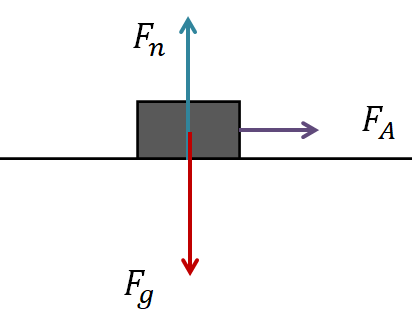
In the example above, there is only one object. Sometimes you may have a system that contains more than one object. In that case, draw a force diagram for each object separately and apply Newton's second law to each.
Solving problems with Newton's second law
To apply Newton's second law, you need to add all the forces acting on the object to get the net force. Remember that force is a vector, so you must use vector addition when adding forces. If more than one force acts on the object, work with the forces on each axis separately. Since the $x$ and $y$ components of a force are independent, the net force along the $x$ direction affects only the motion in that direction, and likewise for the $y$ direction. So you need to apply Newton's second law on each axis separately:$F_x=ma_x$ and
$F_y=ma_y$
where $F_x$ and $F_y$ are the net forces along the $x$ and the $y$ direction; $a_x$ and $a_y$ are the acceleration of the object in the $x$ and the $y$ direction.
If an object is moving along the $x$ axis, then there is no motion along the $y$ axis, so $a_y=0$. And if the object is moving along the $y$ axis, then $a_x=0$. Also, you can drop the subscript on the acceleration when the object is moving along one of the axes.
If a force is along neither the $x$ axis nor the $y$ axis, then find its $x$ and $y$ components and work with those components.
Example: A box of mass 11 kg is pulled by a force, $\vec F_p = 32 N$, at an angle of 25 degrees above the horizontal. The box is moving along the floor.(a) find the normal force on the box, and
(b) find the acceleration of the box.
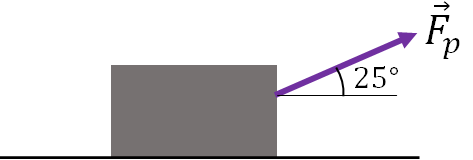
Solution:
First, draw the $x$ and the $y$ axes. Then draw all the forces acting on the object, which is the free body diagram.
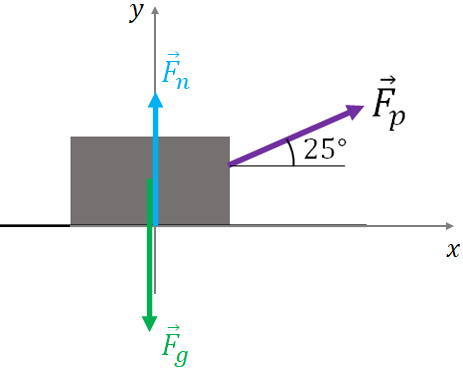
There are three forces acting on the object: the force of gravity, the normal force from the surface, and the applied (pulling) force.
Second, check whether all the forces lie along the $x$ or $y$ direction. If a force does not, then find its $x$ and $y$ components, which lie along the $x$ and the $y$ direction respectively.
$F_n$ and $F_g$ are along the $y$ axis. Since the pulling force $\vec F_p$ is along neither the $x$ axis nor the $y$ axis, you need to find its $x$ and $y$ components. Drawing the components of $\vec F_p$, we get,
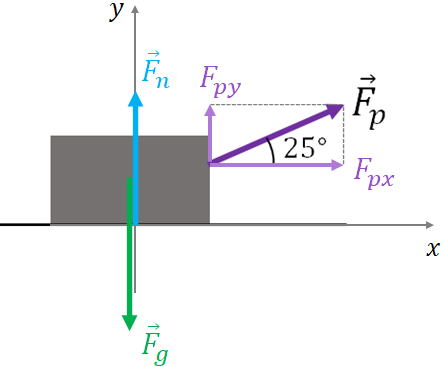
From the figure, we can write,
$F_{px}=F_p \cos (25)= 32 \cos(25)=29N $
and$F_{py}=F_p \sin (25)= 32 \sin(25)=13.52N $
(a) Finding the normal force:
Since the normal force is along the $y$ axis, add all the forces (or components) in the $y$ direction and apply Newton's second law. Note that the $y$ direction means both the positive and the negative $y$ directions.
Net force in the $y$ direction is
$F_y=F_n-mg+F_{py}$
I put a $-$ sign on the force of gravity because it points downward, and a $+$ sign on $F_{py}$ because it points upward.Now, applying Newton's second law:
$F_y=ma_y$
Since the box does not move in the $y$ direction (it moves in the $x$ direction), $a_y=0$. Putting this into the equation, we get,
$F_y=0$
Substituting $F_y$ from the previous equation,
$F_n-mg+F_{py}=0$
Solving for $F_n$
$F_n= mg-F_{py}$
Substituting the values of $m$, $g$ and $F_{py}$,
$\boxed{F_n=94N}$
Note that the pulling force changes the normal force on the box: if there were no pulling force, then
$F_n=mg=110 N$ after rounding to correct significant figures.
So, here, the pulling force reduces the normal force.(b) Finding the acceleration:
Since the box moves in the $x$ direction, add all the forces in the $x$ direction (positive or negative) and apply Newton's second law in that direction. There is only one force in the $x$ direction, $F_{px}$. So the net force in the $x$ direction is $F_{px}$:
$F_x=F_{px}=29N$
Applying Newton's second law:
$F_x=ma_x$
Substituting the values and solving for $a_x$,
$\boxed{a_x= 2.6 m/s^2}$.
Two hanging masses over a pulley
Here, two masses, $m_1$ and $m_2$, hang from a rope that runs over a pulley. Assume $m_2 > m_1$.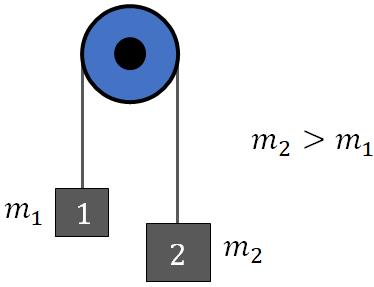
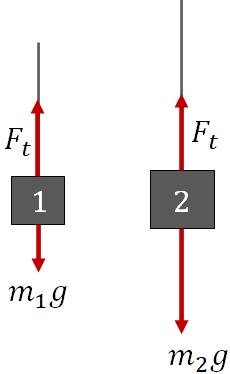
We are going to find the acceleration of the masses and the tension in the rope. Since the two masses are connected by a rope, both have the same magnitude of acceleration, $a$, but their accelerations point in different directions. If we take upward as positive, then the acceleration of mass 1 is positive and that of mass 2 is negative:
$a_1=a$ and $a_2=-a$
All the forces are vertical, either upward or downward; that is, the forces lie only along the $y$ axis. So we just need to consider the net force on each object along the $y$ axis.
For object 1, the net force on it is
$F_t-m_1g=m_1a_1$
Substituting $a_1=a$,
$F_t-m_1g=m_1a$ (1)
For object 2, net force is
$F_t-m_2g=m_2a_2$
Substituting $a_2=-a$,
$F_t-m_2g=-m_2a$ (2)
Solving equations (1) and (2) for $a$ and $F_t$ we get,
$a=g\, \dfrac{m_2-m_1}{m_1+m_2}$
and$F_t=\dfrac{2g\, m_1 m_2}{m_1+m_2}$
Note that when $m_1=m_2$, $a=0$ and there is no motion of the masses.
Friction
When you try to slide an object across a surface, the microscopic bumps on the surface impede the motion. If the surface is smooth, you need less force to move the object; a rough surface requires more. Friction is a resistance that results from these microscopic bumps. It prevents an object at rest from moving when a force is applied. If the object is in motion, friction acts in the direction opposite to the motion and tries to stop it. Friction is a force that acts parallel to the surface.Static friction
Suppose you have an object at rest on a horizontal surface. You try to move it by applying a horizontal force, $\vec F_A$. Your force is not strong enough, so the object does not move. Since the object is at rest, the net force on it must be zero. So there must be another horizontal force, of the same magnitude as the applied force but in the opposite direction, acting on the object so that the net force is zero. This opposing force is the force of friction. Since the object is not moving, we call this friction static friction. Static friction prevents an object from moving when a force is applied.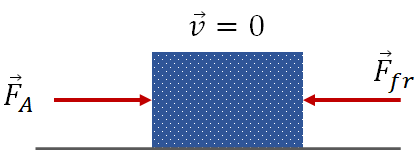
If you increase the applied force, the friction also increases and balances it, until the object starts moving. So, while the object is not moving, the magnitudes of the applied force and the friction force are equal:
$F_{fr}=F_A$, if the object is not moving.
If you keep increasing the force, at some point the object starts moving. The friction at the instant the object just starts moving is the maximum friction.
It has been found experimentally that the magnitude of the maximum friction is proportional to the normal force exerted on the object by the surface:
i.e., $(F_{fr})_{max}=\mu_sF_n$
where $\mu_s$ is the coefficient of static friction between the object and the surface. Its value depends on the surface and the object.
Kinetic friction
If the applied force on an object exceeds the maximum friction, the object starts moving. Once the object is moving, the friction drops by some amount. The friction force acting on an object in motion is called kinetic friction. Kinetic friction acts in the direction opposite to the motion.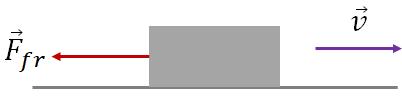
Kinetic friction is proportional to the normal force exerted on the object by the surface:
$F_{fr}=\mu_kF_n$
where $\mu_k$ is the coefficient of kinetic friction between the object and the surface.
$\mu_s$ is always greater than $\mu_k$.
Smooth surfaces:
We will use the term "smooth surface" to refer to a surface with no friction. So, on a smooth surface, $\mu_s=0$ and $\mu_k=0$, and we ignore the friction force on an object on such a surface. Note that in reality, there is no perfectly smooth surface.
Inclines
An incline is a flat surface tilted relative to the horizontal. One end of the incline is higher than the other. In the figure below, an object is on an incline. The angle of the incline is $\theta$, the angle of the surface from the horizontal.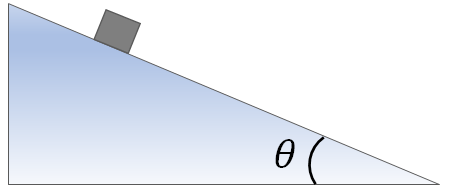
You learned that the normal force on an object from a surface is perpendicular to the surface. If the surface is horizontal, then the normal force points vertically upward. Since an inclined surface is not horizontal, the normal force is not vertical.
The force diagram for an object on a smooth (frictionless) inclined surface is shown in the following figure. The normal force and the force of gravity on the object are shown below. Remember that the force of gravity always acts vertically downward, no matter where the object is. As usual, we take the normal force to be along the $y$ axis, and the $x$ axis along the inclined surface.
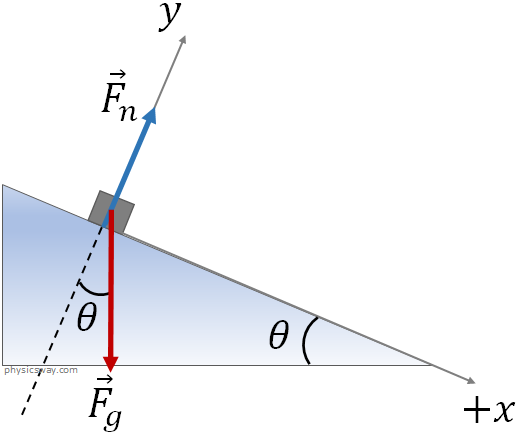
We always work with forces along the $x$ and $y$ axes. Here, the normal force is along the $y$ axis, but the force of gravity is along neither the $y$ axis nor the $x$ axis. So we will find its $x$ and $y$ components.
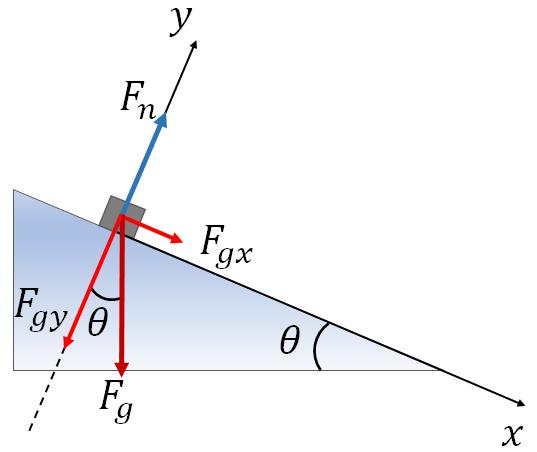
From the geometry of the figure, the $x$ and the $y$ components of the force of gravity are,
$F_{gx}=mg\sin\theta$
$F_{gy}=-mg\cos\theta$
On an incline, any motion of the object takes place only along the $x$ axis, with no motion along the $y$ axis. Therefore, the net force along the $y$ axis is zero.
So, adding all the forces along the $y$ axis, we get,
$F_n-mg\, \cos\theta=0$
or$F_n=mg\cos\theta$.
Objects in rest on an incline:
An incline may be frictionless (smooth) or may have friction. If there is no friction, an object cannot stay at rest on an incline, because the force of gravity will bring it down. So there must be a friction force between the object and the surface for the object to remain at rest. Along the $x$ axis, two forces act on the object: the $x$ component of the force of gravity, $F_{gx}$, which acts downhill, and the friction, which acts opposite to $F_{gx}$. For the object to stay put, $F_{gx}$ must be smaller than the maximum static friction; otherwise the object will slide down. When the object is at rest, the friction force balances $F_{gx}$. So the magnitude of the friction force on the object is$F_{fr}=mg\sin\theta$.
This is the friction force on an object in rest on an incline.
Object's motion on an incline:
On an incline, an object can either slide down from the top after being released, or move up from the bottom after being given some initial velocity (an initial push).Object is sliding down: The free body diagram of an object sliding down is shown below. When the object slides down, the friction force acts uphill to impede the motion.
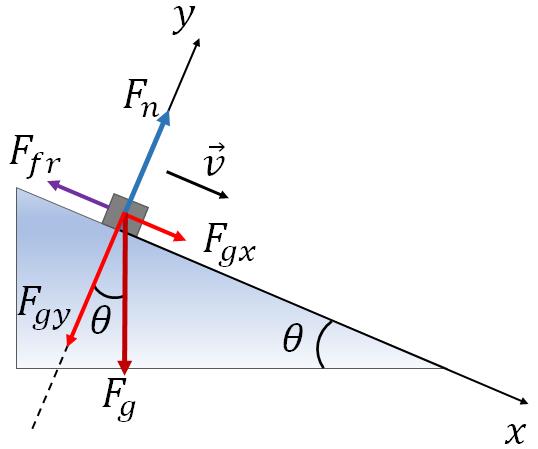
Applying Newton's second law along the $x$ axis, we have
$-F_{fr}+mg\sin\theta=ma$
Note that I have taken downhill as the positive $x$ direction.You can find the magnitude of the friction force by using the equation:
$F_{fr}=\mu_k\:F_n$.
Substituting $F_n$ for an incline:
$F_{fr}=\mu_k\:F_n=\mu_k\:mg\cos\theta$.
Substituting this in the above equation and dividing out the mass, $m$, you will get,
$a=-\mu_k\:g\cos\theta+g\sin\theta$
This is the acceleration of the object that is sliding down.
Object is sliding up:
If you give an initial push to an object at the bottom of an incline, it can move uphill. Since friction always acts opposite to the direction of motion, the friction now acts downhill. So the friction force is now positive, and as a result the first term in the acceleration is now positive:$a=\mu_k\:g\cos\theta+g\sin\theta$
This is the acceleration of the object that is sliding up.