
Circular motion
When an object moves along a circular path, its motion is called circular motion. Common examples include a ball swinging in a circle at the end of a string, and the Moon orbiting the Earth. On this page, you will learn about the following topics:- Uniform circular motion
- Banked and unbanked highway curves
- The law of universal gravitation
- Acceleration due to gravity on planets
- Kepler's laws
Velocity of an object in a circular motion
In the animation below, an object is shown moving in circular motion. The red arrow represents the object's velocity vector. Notice that the direction of the velocity changes continuously — at any given instant, it is always tangent to the circle.Uniform circular motion
If the speed of an object in circular motion is constant, the motion is called uniform circular motion. Even though the speed is constant, the velocity is not, because the direction of the velocity changes continuously. Therefore, an object in uniform circular motion has an acceleration.Centripetal force
According to Newton's first law, an object in motion continues moving in a straight line as long as no net external force acts on it. Circular motion is not motion along a straight line, so there must be a net external force acting on the object to keep it on the circular path. This net external force is called the centripetal force, $\vec F_c$.When a ball attached to a string swings in a circle, the string pulls the ball toward the center of the circle. So the string exerts a force on the ball directed toward the center. This force is the force of tension, and it is what keeps the ball in circular motion. So, in this case the centripetal force is the force of tension.
The Moon revolves around the Earth in a nearly circular orbit. The gravitational force exerted on the Moon by the Earth keeps the Moon in its orbit. So, in this case the force of gravity is the centripetal force. This force points toward the center of the Earth, which is the center of the circle. Thus, the direction of the centripetal force on any object in circular motion is toward the center of the circle.
Acceleration in uniform circular motion
The acceleration of an object undergoing uniform circular motion is called centripetal acceleration, $\vec a_c$. This acceleration arises from the centripetal force acting on the object, and so it always points toward the center of the circle. Alternatively, the direction of the centripetal acceleration can be determined from the velocity vector, as demonstrated in the following video.If an object is in uniform circular motion on a circle of radius $r$, with speed $v$, then the magnitude of the centripetal acceleration of the object is
$a_c=\dfrac{v^2}{r}$
The derivation of this equation is given in this page, deriving centripetal acceleration.
Magnitude of the centripetal force
The centripetal force is related to the centripetal acceleration by Newton's second law,$\vec F_c=m\, \vec a_c$
where $m$ is the mass of the object.
So, the magnitude of the centripetal force is
$F_c=ma_c=\dfrac{mv^2}{r}$
Period of circular motion
An object in circular motion repeats its motion after a certain time interval. This time interval is the period of the circular motion. So the period, $T$, is the time taken by the object to complete one full circle. In a time $T$, the object travels a distance equal to the circumference of the circle, $2\pi r$. From this distance and time, we can find the speed of the object,$v=\dfrac{2\pi r}{T}$
Solving for $T$, we will get the period,
$T=\dfrac{2\pi r}{v}$
Unbanked and banked highway curves
There are two types of highway curves (or roads): unbanked and banked. A banked curve is advantageous during the snowy season, as it gives vehicles better control and helps prevent them from sliding off the road while making a turn.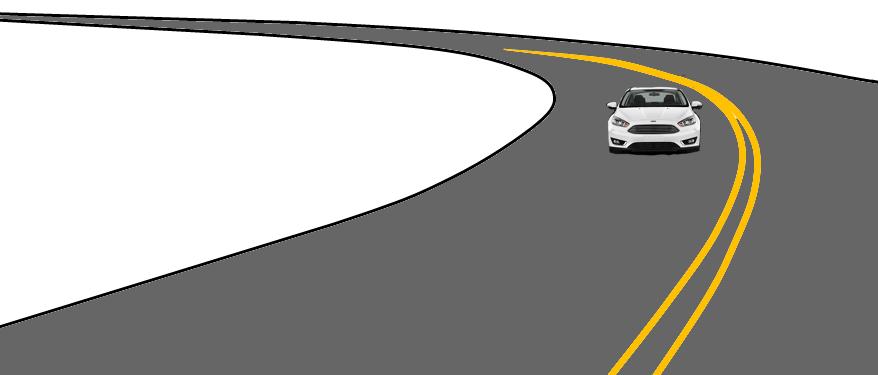
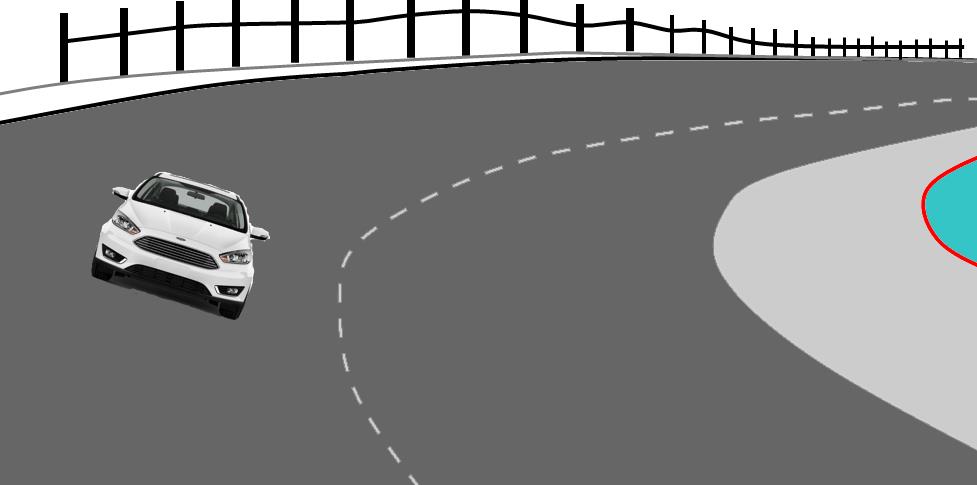
Unbanked curve
Unbanked roads are horizontal, or flat, roads. When a car or truck travels on an unbanked curve, it is in circular motion. If a flat road is icy and has no friction, a car cannot follow a curve. So, on an unbanked road, friction is required to follow a curve, which means that friction provides the centripetal force. The centripetal force on the vehicle is therefore$F_c=F_{fr}$
where $F_{fr}$ is the force of friction between the road and the tires of the vehicle.
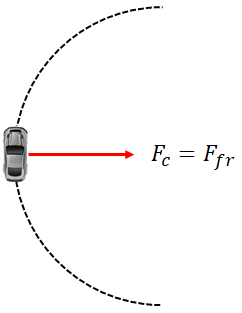
Now, the question is: what type of friction provides the centripetal force to a vehicle on an unbanked flat road — static or kinetic? Since friction is the centripetal force on a horizontal curve, it must point toward the center of the circle. But the vehicle has no motion in that direction, so the friction is static.
Depending on the friction between the road and the tires, there is a maximum speed above which a car cannot follow a curve or make a turn on a flat road. This maximum speed, $v_{max}$, can be obtained by equating the centripetal force to the maximum available force of friction:
$\dfrac{mv_{max}^2}{r}=\mu_sF_n$.
If $m$ is the mass of the vehicle, then the normal force on the car is $F_n=mg$. Substituting this into the above equation and solving for $v_{max}$, we get,
$v_{max}=\sqrt{\mu_s rg}$This is the maximum speed at which a car can safely follow a horizontal curve. If there is ice on the road, $\mu_s$ decreases, which reduces the safe speed. Note that the maximum speed is independent of the mass of the vehicle.
Banked curve
A banked curve is tilted above the horizontal by an angle, usually toward the inside of the curve. This angle of tilt is called the banking angle. The path of a banked curve is actually part of a horizontal circle, as shown in the figure below. For a car or truck to follow the curve, there must be a horizontal force acting on it toward the center of the circle, which is the centripetal force.How can there be a horizontal force on the car so that it can follow the curve? If you look at the normal force on the car, it is not vertical. This means there is a horizontal component of the normal force pointing toward the center of the circle. This component acts as the centripetal force required for the car to follow the curve.
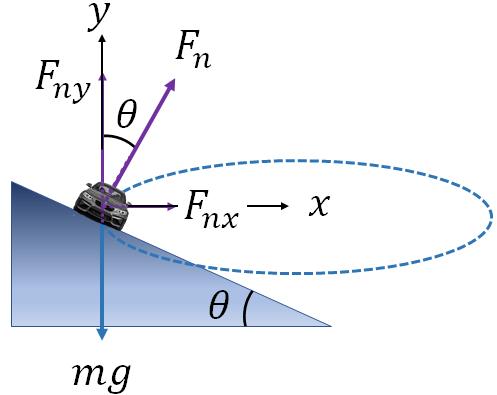
Let us take the $x$ axis pointing toward the center of the circle and the $y$ axis vertical. From the geometry of the figure, you can see that the normal force is at an angle $\theta$ from the vertical. Finding the $x$ and $y$ components of the normal force, we have
$F_{nx}=F_n \sin\theta$ and
$F_{ny}=F_n \cos\theta$
Since the $x$ component of the normal force is the centripetal force, we can write
$F_n \sin\theta=\dfrac{mv^2}{r}$
From the figure, the normal force does not balance the force of gravity, $mg$, but its $y$ component does. Therefore,
$F_n \cos\theta=mg$.
Dividing the previous equation by this equation, we get,
$\tan \theta = \dfrac{v^2}{rg}$
Solving for $v$,
$v=\sqrt{rg\tan\theta}$
This $v$ is called the design speed, or the safe speed to drive on a banked curve. The design speed is independent of the mass of the vehicle.Note that in deriving the above equation, we ignored the friction force exerted on the tires by the road. So a car can follow a banked curve even without friction.
Law of universal gravitation
The law of universal gravitation was published by Isaac Newton in 1687. It states that"every particle in the universe attracts every other particle with a force, which is proportional to the product of their masses and inversely proportional to the square of the distance between them."
If there are two objects, they attract each other with a force called gravitational force. The magnitude of the gravitational force between any two objects is given by
$F_g=G\dfrac{m_1m_2}{r^2}$
where $m_1$ and $m_2$ are the masses of the objects; $r$ is the distance between the objects, measured from center to center; and $G$ is a constant called the gravitational constant. The value of $G$ is$G=6.67\times10^{-11}Nm^2/kg^2$.
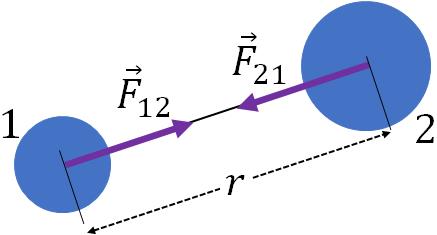
In the figure, you can see that object 1 exerts a gravitational force $\vec F_{21}$ on object 2, and object 2 exerts a gravitational force $\vec F_{12}$ on object 1, each directed toward the other. According to Newton's third law, these two forces are equal and opposite. Their magnitudes are given by the law of gravitation, that is,
$|\vec F_{12}|=|\vec F_{21}|=F_g$
Acceleration due to gravity on or near a planet
You have already learned that near the surface of the Earth, the acceleration due to gravity, $g$, is $9.80 m/s^2$. This value is valid only near the Earth's surface; the acceleration due to gravity decreases with altitude.Now, we will derive an equation for the acceleration due to gravity near a planet or other celestial object. Let $M_p$ be the mass of the planet. Suppose we want to find the acceleration due to gravity at a point P, located at a distance $r$ from the center of the planet. Imagine a test object of mass $m$ at P.
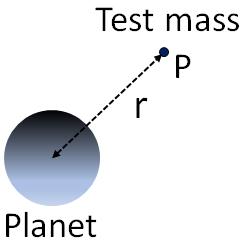
Let $g$ be the acceleration due to gravity at point P. Then the force of gravity on the test object is
$F_g=mg$
The force of gravity is just the gravitational force exerted on the object by the planet, which we can also find using the law of universal gravitation,
$F_g=G\dfrac{mM_p}{r^2}$.
Equating the two equations above and solving for $g$, we get,$g=\dfrac{GM_p}{r^2}$.
Acceleration due to gravity depends on the planet's mass and the distance from its center. It decreases with distance as $1/r^2$, an inverse square law.
On the surface of the Moon, the acceleration due to gravity, $g$, is about one-sixth of that on Earth, because of the Moon's smaller mass.
Satellites
Satellites revolve around the Earth in nearly circular orbits. Man-made satellites are used for many applications, from weather forecasting to navigation. Since a satellite is in circular motion, there must be a centripetal force acting on it. This centripetal force is the gravitational force exerted on the satellite by the Earth.If $m$ is the mass of a satellite that is revolving around the Earth, then the gravitational force on the satellite by the Earth is
$F_g=G\dfrac{M_E\,m}{r^2}$.
where $M_E$ is the mass of the Earth and $r$ is the radius of the orbit, which is the distance of the satellite from the center of the Earth.
Since the gravitational force is the centripetal force, we have
$\dfrac{mv^2}{r}=G\dfrac{M_E\,m}{r^2}$.
Solving for $v$,we get,
$v=\sqrt{\dfrac{GM_E}{r}}$.The above equation does not contain $m$, the mass of the satellite, so the speed of a satellite is independent of its mass. The speed depends only on the distance $r$, varying as $1/\sqrt{r}$. So the closer a satellite is to the Earth, the faster it moves.
Geosynchronous satellites
Satellites that appear to stay at the same spot above the Earth are called geosynchronous satellites. For a satellite to be geosynchronous, it must meet two conditions: (i) its orbital period must be the same as the Earth's rotational period, and (ii) its orbit must be aligned exactly with the Earth's equator. So the period of a geosynchronous satellite is one day, the Earth's rotational period. Because a geosynchronous satellite appears fixed at one spot above the Earth, such satellites are used for television broadcasts and communications. Based on the period, we can estimate that a geosynchronous satellite orbits the Earth at a height of approximately 36,000 km with a speed of about 2800 km/h.Weightlessness
We feel our weight because of a normal force acting on us. When there is no normal force, we feel weightless. You can experience this in an elevator: when the elevator accelerates downward, you feel lighter, and when it accelerates upward, you feel heavier. The weight you feel is the normal force (also called the apparent weight) exerted on you by the floor of the elevator. As you already learned in "Forces," the normal force on a person in an elevator is$F_{n}=mg+ma$
where $a$ is the acceleration of the elevator (or the person).If the elevator cable suddenly breaks, the elevator and the person are in free fall. Since the person is in free fall, their acceleration is $a=-g$. Substituting this into the above equation gives $F_{n}=0$, so the person feels weightless. An astronaut in a spacecraft is also in free fall along with the spacecraft, since gravity is the only force acting on them, and so the astronaut feels weightless too. Note that one feels weightless because of the absence of a normal force. Although the apparent weight is zero during free fall, the person's actual weight is not zero — it is still $mg$.
Planetary motion
All the planets, including Earth, revolve around the Sun. Johannes Kepler (1571–1630) developed three laws to describe the motion of the planets around the Sun. These laws were developed in the 1600s, about 50 years before Newton's laws.Kepler’s first law:
Each planet revolves around the Sun in an elliptical path with the Sun at one focus.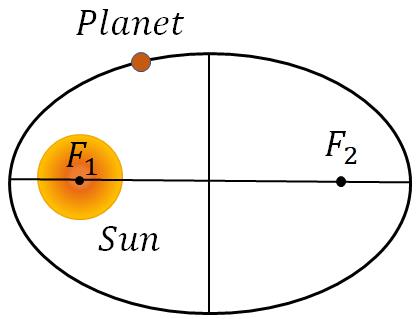
Kepler’s second law:
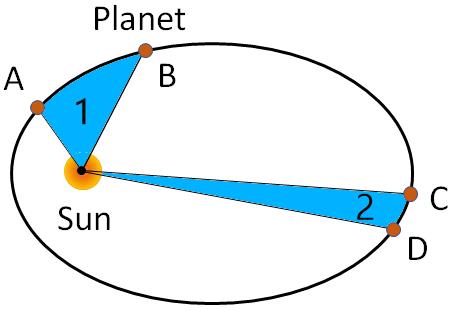
An imaginary line drawn from the Sun to a planet sweeps out equal areas in equal times.In the figure, the shaded areas 1 and 2, are the same if the time taken by the planet to move from A to B is same as that from C to D.
Kepler’s third law:
The ratio of the squares of the periods of any two planets revolving around the Sun is equal to the ratio of the cubes of their mean distances from the Sun.$\bigg(\dfrac{T_1}{T_2}\bigg)^2=\bigg(\dfrac{s_1}{s_2}\bigg)^3$
where $T_1$ and $T_2$ are the periods of planets 1 and 2, and $s_1$ and $s_2$ are their distances from the Sun. For circular orbits, $s=r$, the radius of the orbit.